






New Webinar: How to build a scalable EPD system to win tenders Watch Now ➜

New Webinar: How to build a scalable EPD system to win tenders Watch Now ➜

New Webinar: How to build a scalable EPD system to win tenders Watch Now ➜

Measure and reduce your products’ environmental impact

LCA is the science-based method used to evaluate the environmental impact of a product or process throughout its entire life cycle. With Ecochain’s LCA software, you run accurate life cycle assessments across your product portfolio without deep LCA expertise or a six-figure consulting budget. You get the foundation, the calculations and the outputs (EPDs, PCFs, hotspot analysis, and more) in a fraction of the time it takes with legacy tools or traditional consulting.

Trusted by 450+ industrial manufacturers across construction, infrastructure and equipment sectors

A single LCA foundation for the environmental impact assessment of your entire product portfolio

With Ecochain, you turn product and production data into reliable environmental footprints for any product in your portfolio – without deep LCA expertise or a new consulting project for every calculation.

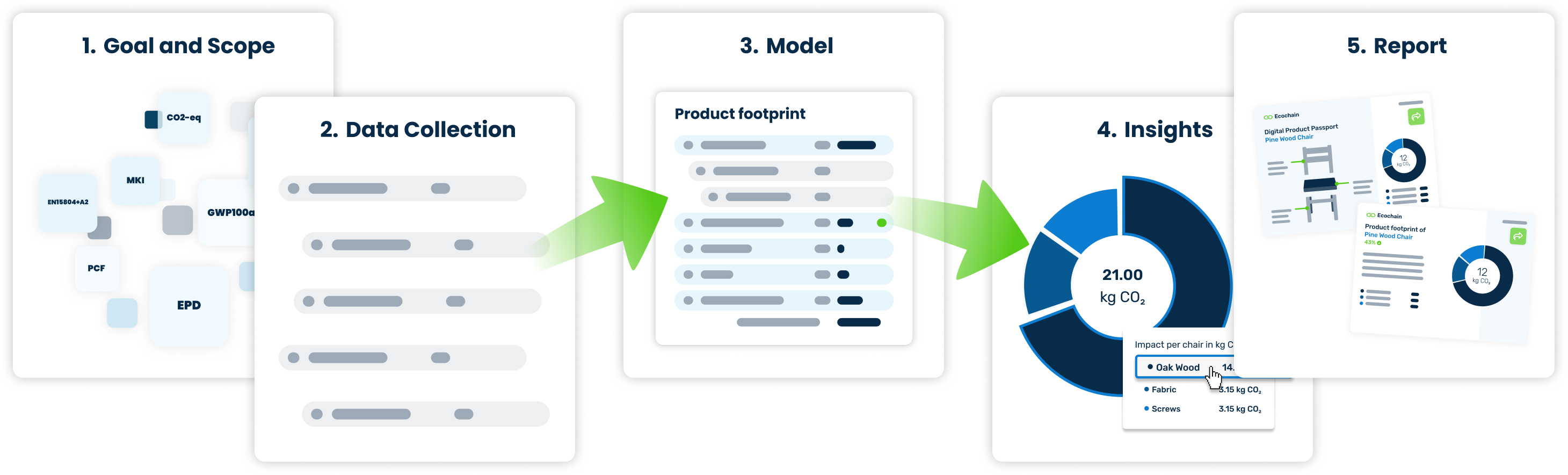
From product data to verifiable LCA results – in four steps

Each step builds directly on the one before it, using the same product and production data you set up in Step 1. Nothing gets re-entered or rebuilt as you move from a screening LCA to a full model, or from an internal hotspot report to a published EPD or PCF.

Collect

Step 1: Turn scattered product data into an LCA one-stop-shop

Import bills of material, energy consumption and supplier data via CSV, XLSX or API. Combine your own primary production data with secondary emission factors from ecoinvent, PEF, World Steel or other databases you need. Ecochain organizes it into a consistent, auditable foundation for all your LCA calculations.

Measure

Step 2: Build product-specific LCA models you can adapt, not rebuild

Your structured product data becomes full life cycle assessment models, aligned with ISO 14040/14044 and EN 15804+A2. Primary data where you have it, trusted secondary databases where you don’t – so results reflect how your products are actually made. Define goal, scope and allocation rules, and pick the right LCIA methods for your use case, with guidance from our team when you want it.

Share

Step 3: Generate and publish EPDs, PCFs and more, directly from one LCA data foundation

Once your foundation is in place, the same models do double duty. Generate verifiable EPDs, self-declared or verifiable PCFs, environmental profiles and detailed reports from one data source – then reuse the same results for procurement, Scope 3 reporting, leadership updates and product decisions. Publish to any program operator, or several, without reformatting.

Improve

Step 4: Use LCA insights for ecodesign and better product decisions

Ecochain’s LCA system gives you more than a total impact number – it shows your product’s full environmental footprint, broken down by material, energy and water use, waste, production processes and life cycle stage. You see exactly where impact concentrates, and where the biggest reductions sit. Run scenario comparisons to test material swaps, supplier changes or design alternatives before committing, and give R&D and procurement the data they need to decide.

LCA analysis software that scales with your portfolio, not against it

Whether you’re starting with one product or need to cover a facility with hundreds of variants, Ecochain scales your LCA studies to match where you are now and where you’re going next.

Choosing LCA software? Know what to ask before you sign.

The LCA software buyers guide walks through what to look for in your next Life Cycle Assessment (LCA) software, when each thing matters, 8 red flags to watch for and 12 questions that tend to expose how a tool really behaves once you’re past the demo.

LCA results your whole team can rely on for product sustainability reporting

For sustainability and product teams

Run LCAs without becoming an LCA expert

The questions keep coming – from procurement, leadership, verifiers. Ecochain gives you a structured, accurate way to run LCAs and answer them, without rebuilding your methodology for every project. Set up your foundation once, then respond in days, not weeks.

For sales and marketing

Back every claim with product-specific data

Industry averages don’t hold up in competitive tenders. Ecochain gives you LCA results that reflect the real environmental performance of each product – so when customers question your numbers, you have defensible, product-level data to stand behind.

For leadership

Scale LCA coverage without scaling costs

Regulatory pressure is moving fast – CPR, ESPR, CBAM, DPP. Ecochain gives your team the infrastructure to run LCAs across the whole portfolio, build once and scale, without adding headcount or signing open-ended consulting retainers. Accurate, defensible data at a fraction of the cost.

See how manufacturers generate LCAs and product footprints at scale with Ecochain​

Frequently asked questions about LCA software

LCA (life cycle assessment) software models and calculates a product’s environmental impact across its full life cycle – from raw material extraction through manufacturing, use and end of life. Manufacturers use it to generate verifiable EPDs, product carbon footprints (PCFs), hotspot reports and environmental profiles that meet ISO standards and regulatory requirements. It’s also used for internal decisions: comparing materials, identifying high-impact processes and supporting ecodesign. 

No, you don’t need to be an LCA expert to use LCA software. Ecochain’s software is built for people managing product sustainability projects, not LCA PhD experts. You set the goal, and the software guides you through data setup, model building and the standards that apply. If you’d rather not do it alone, our product experts can pick up as much or as little as you want – from a single question to running the whole project. Most customers land somewhere in between: they build in-house once they’ve done it with us the first time.

How long it takes to run an LCA study with Ecochain software depends on two things: how quickly you can gather your product data, and whether you want third-party verification. Setting up your LCA workspace – defining system boundaries, importing BOMs and production data, building your model – typically takes a few days to a few weeks depending on portfolio complexity and data availability. Ecochain’s LCA experts can accelerate this significantly. Once your foundation is set up, generating additional LCA results for new products is fast. If you need third-party verification (required for EPDs if you’re participating in public tenders), factor in a few additional weeks for the verifier’s review process.

Ecochain gives you access to all major secondary life cycle inventory (LCI) databases including ecoinvent (versions 3.12 or lower), PEF, World Steel, World Food LCA Database and PlasticsEurope. You’re not locked into a single dataset. You can also import primary supplier data and combine it with secondary data for more accurate, product-specific results. Working with a dataset Ecochain software doesn’t carry? Our LCA experts can help source, validate and add it to your model.

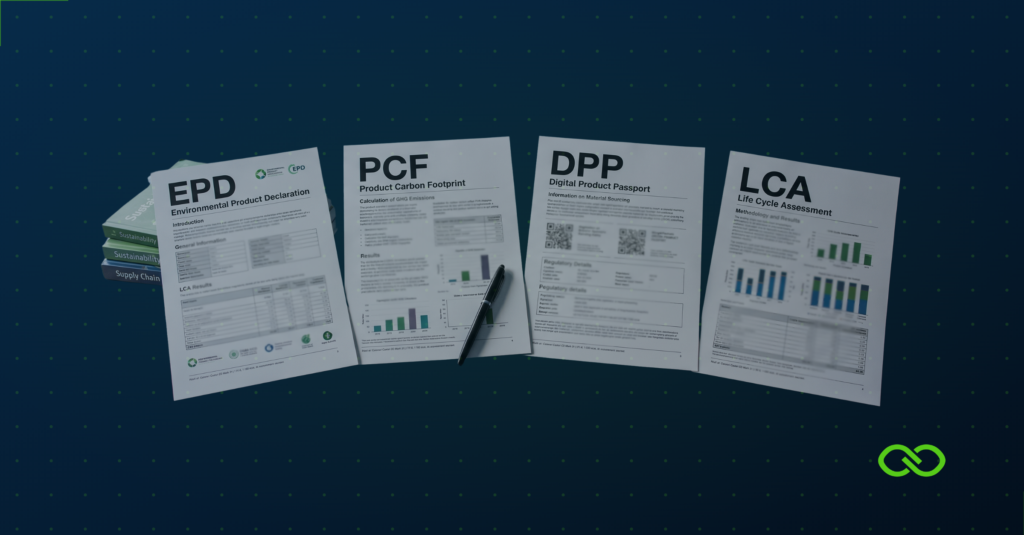
From a single LCA data foundation in Ecochain software, you can generate:

  • Verified or self-declared Environmental Product Declarations (EPDs), compliant with EN 15804+A2
  • Product Carbon Footprints (PCFs), aligned with ISO 14067 and GHG Protocol
  • Hotspot reports identifying high-impact materials and processes
  • Environmental profiles and LCA reports for internal use or stakeholder disclosure
  • Data formatted for Digital Product Passports (DPPs) – relevant as ESPR and CPR requirements evolve

Ecochain’s calculations are aligned with ISO 14040, ISO 14044 (the core LCA methodology standards), ISO 14067 (carbon footprint of products), EN 15804+A2 (European standard for construction product EPDs) and GHG Protocol. The software supports multiple LCIA methods including EF 3.1, ReCiPe, IPCC and TRACI.

Ecochain offers customizable, product-specific LCA models instead of portfolio-wide averages. Software paired with expert services, so you’re not dependent on outside consultants. A verify-once-pay-once model that makes running EPDs and PCFs at portfolio scale actually affordable. 2M+ LCAs conducted and 15+ years focused on manufacturing in the UK, Ireland, Netherlands and Germany, means we know what a verifier is going to ask before they ask it. 

Continue reading: The 12 best LCA software tools for manufacturers (2026)

Yes – Ecochain is built specifically for manufacturers. The software uses activity-based footprinting, which maps your actual manufacturing processes, energy use and material inputs to product-level outputs. This is particularly relevant for multi-product facilities where the same production line produces hundreds of variants: you set up the facility model once, and generate LCA results for each product variant from that shared foundation.

A screening LCA is a simplified, faster version of a full LCA that uses secondary (industry-average) data rather than your own primary production data. It’s useful in the early stages of sustainable product development or when you need a quick environmental assessment to identify which areas of impact matter most before committing to a full study. Ecochain software supports both screening and full LCA studies, and can help you move from one to the other as your data matures.

Would you like to discuss your LCA needs with our team?

Book a call to explore how we can help you run life cycle assessments at scale, and whether Ecochain is the right fit.

Artjom Janssen