Summary (TL;DR) of what this article covers
- This is a decision-making guide for sustainability managers asking “which product footprint report do I need?”. This guide covers whether the request came from sales, R&D, procurement, or a compliance team, and whether the answer is an LCA, EPD, PCF, or DPP.
- The most important first step in LCA deliverable selection isn’t picking an output. It’s asking the question behind the question: what is this actually for? The same request could mean something completely different depending on who’s asking and why.
- Five clarifying questions are presented to help determine the right environmental product certification or reporting output: internal or external use, verification requirement, CPR market, carbon-only or full environmental profile, and whether the request is likely to repeat.
- Verification requirements differ by use case. For internal hotspot analysis and R&D decisions, third-party verification adds cost without realistically adding value. For anything shared externally, considering a third-party verification of an EPD for a construction tender, a PCF for Scope 3 requests, or regulatory documentation is the right route.
Why ‘I need a carbon footprint’ isn’t enough to choose the right LCA output?
Picture this: you’re a sustainability manager with several different environmental footprint requests on your desk.
Sales needs “a carbon number” for a tender submission closing Friday. Procurement wants “product environmental data” to include in a supplier questionnaire response. R&D is asking for “impact calculations” to support a material substitution decision. Plus, your manager has forwarded an email from a key customer asking for “sustainability documentation” without specifying the exact format.
Four requests, with four different outputs. If you work on them without more information, there’s a chance you’ll spend weeks producing something that doesn’t actually fit their needs.
Sustainability managers at construction product and industrial manufacturers describe this exact scenario in conversations with us all the time. The question is not what Environmental Product Declarations (EPDs) or Product Carbon Footprints (PCFs) are in theory, but about which one is needed in specific situations. Often, the person applying pressure is unsure what they’re asking for, making the task all the more challenging.
The acronyms don’t make things any easier. Terms like EPD, PCF, LCA, and DPP, and DoPC can make any request feel more technically complex than it probably is. This complexity can lead teams toward the wrong output. The cost of picking the wrong reporting output isn’t just wasted time. It can mean mid-project changes, missed tender deadlines, or a deliverable that satisfies the request on paper but doesn’t serve the underlying need.
In a recent episode of our Behind the Product Impact video series, Dr. Pratik Gholkar, our Sustainability Strategist, and Emma Thunnissen, Sustainability Expert at Ecochain, work through the challenge of selecting the right product footprint report.
For full definitions, timelines, and use cases for each output type, check out this one: EPD vs PCF vs DPP vs LCA: definitions, key differences, timelines and use cases
What is the question behind the product footprint request?
The first step to selecting the right sustainability report for your product is to understand the business objective behind your footprinting request. If you do this before picking any output, you’ll save considerable time.
Dr. Pratik Gholkar has had this conversation dozens of times: “I will always start with the question behind the question. If you are a sustainability manager and your stakeholders – maybe sales, procurement, R&D – come to you with a request like ‘I need [a] carbon footprint [for this product]’, I will always start with: why do you need this? What is the business impact or the business objective you are going to achieve with this product impact calculation?”
We’ve established that the same four words, “I need a carbon footprint”, can mean entirely different things depending on who’s asking and what they’re going to do with it.
Sales requests are often about external communication. They usually need something verifiable, shareable, and credible. Where an R&D team may want it for internal decision-making. Likely to understand where environmental impact comes from, identify hotspots, or compare material options. In this case, third-party verification or a publishable document is unnecessary. Useful numbers are what they need.
Getting this wrong can be expensive. As Pratik puts it, the industry regularly does too much. Sustainability teams will produce detailed, verified EPD reports for requests that only ever needed an internal carbon number. Or worse, producing the wrong output entirely and having to start again.
“Choosing your business objectives and aligning them with the reporting is a crucial step.” – Dr. Pratik Gholkar, Sustainability Strategist at Ecochain
| The main takeaway: Before starting any calculation, ask “what is this actually going to be used for?”. This is one of the highest-value steps a sustainability manager can do before they commit to footprinting calculations. In most manufacturing organizations, that clarity doesn’t exist yet. Part of your job is to create it. |
What is the difference between an EPD, PCF, LCA and DPP, and when to use each?
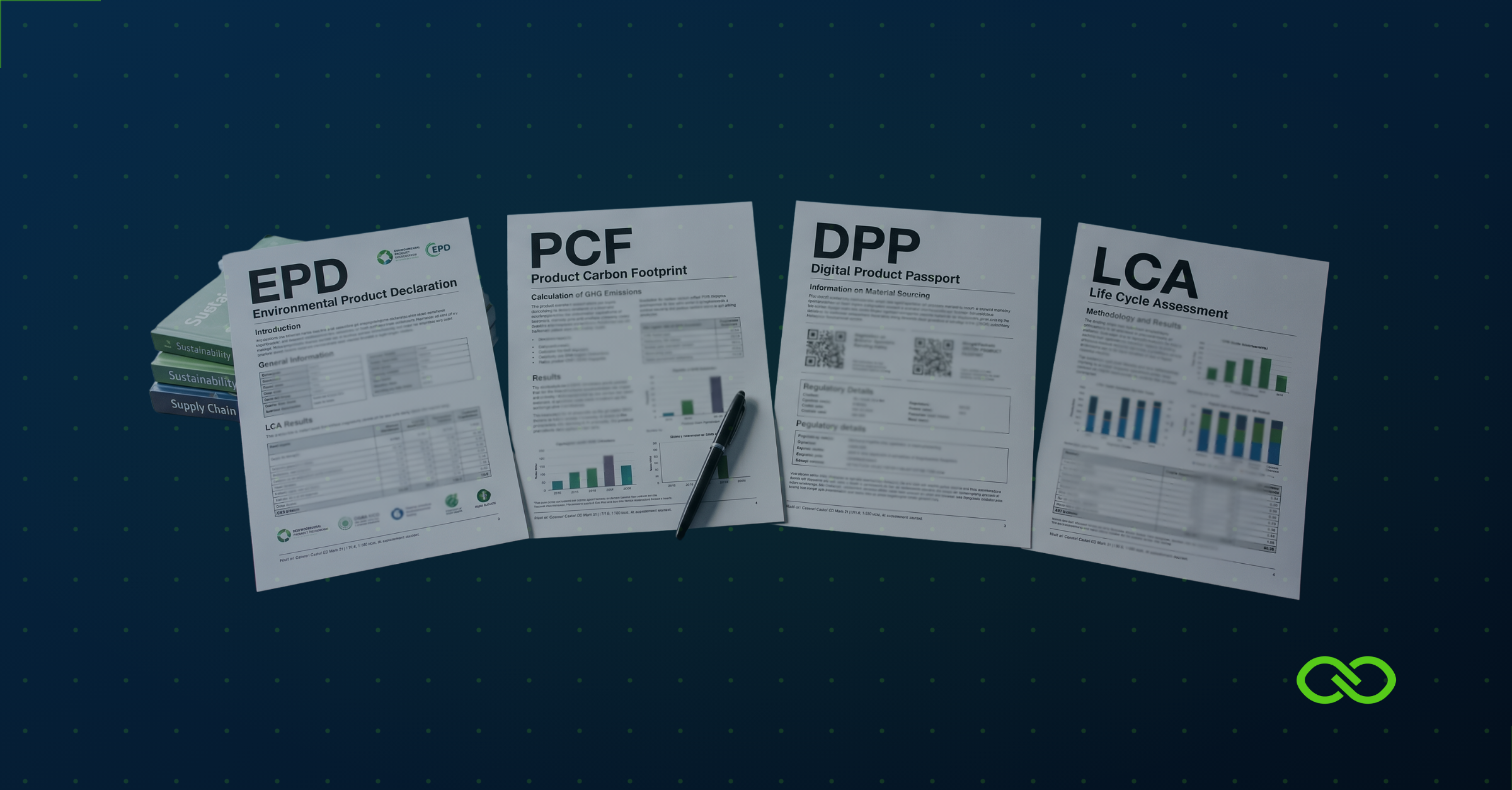
Before going any further, here’s a quick functional overview of the decision framework. For full definitions, timelines, and use cases, see this blog: EPD vs PCF vs DPP vs LCA: definitions, key differences, timelines and use cases.
- Life Cycle Assessment (LCA) – This is the foundation for all environmental reporting – i.e., everything else is built on this. An LCA provides the full picture of your product’s environmental performance. It does so across impact categories, life cycle stages, materials, and processes. When used internally, it drives hotspot analysis, eco-design decisions, and strategic product comparisons. An LCA can be used internally without being verified. Continue reading: Life cycle assessment (LCA) – complete beginner’s guide
- Product Carbon Footprint (PCF) – A PCF focuses specifically on greenhouse gas emissions, usually expressed in kg CO₂ equivalent. It follows standards like ISO 14067 or the GHG Protocol Product Standard, and can be scoped cradle-to-gate or cradle-to-grave depending on the requirement. If you’re responding to a Scope 3 request, ISO 14067 is the more commonly accepted standard in a B2B manufacturing context; the GHG Protocol Product Standard is more widely used in consumer goods. When in doubt, check what the requesting party specifies. Also, PCFs can be verified, but aren’t always. Verification is needed when sharing externally. PCF is common in Fast-Moving Consumer Goods (FMCG) and textiles. Plus, it’s becoming increasingly relevant in the construction sector. Continue reading: Product Carbon Footprint (PCF) – full guide
- Environmental Product Declaration (EPD) – An EPD is a verified, published summary of LCA results, structured according to ISO 14025, or EN 15804+A2 for construction products. It covers multiple environmental impact categories, not just carbon. Third-party verification is most commonly required if you want to publish your EPD on a recognized Program Operator (EPD PO) platform. Common EPD POs in Europe like IBU, EPD International, EPD Global, MRPI are designed for external audiences: customers, tender committees, and regulators. In construction, they’re the standard mechanism for meeting Construction Product Regulation (CPR) environmental reporting requirements. Continue reading: EPD – the complete guide
- Digital Product Passport (DPP) – The DPP is still taking shape. It is mandated through the EU’s Ecodesign for Sustainable Products Regulation (ESPR) and referenced in the revised CPR. DPP will be a digital data container, a structured, machine-readable record of a product’s technical and environmental information. LCA data, EPD results, material declarations, and compliance documentation are all expected to feed into it. Full DPP requirements won’t be defined until 2027, but manufacturers building EPD foundations now are already building their DPP foundation. Continue reading: Digital Product Passports (DPP) – 19 questions answered
| The main takeaway: It’s not about ranking internal LCA, PCF, EPD, or DPP. One isn’t better than the other. They serve different audiences and different purposes. Decide what’s best for your case based on fit. |
Decision framework: How to decide on the right product footprint report?
Here are three practical tools to work through any product footprint request: five clarifying questions, a request-to-output reference table, and a starting principle that keeps early-stage work reusable.
Five questions that narrow down product footprint choices
Ask yourself these questions before committing to one product footprint report:
- Is this for internal use or external communication? If the output stays internal (e.g., informing a design decision, supporting a procurement response, guiding R&D), you likely do not need a verified, published document. A PCF or a simple lifecycle assessment to identify hotspots can be enough in this case. When the output goes externally to a customer, a tender committee, a regulator, or gets published anywhere, verification becomes relevant.
- Is third-party verification required? Verification is what gives an output credibility outside your organization. For EPDs used in tenders or public contracts, it’s mandatory. For PCFs, it depends on the use case and the audience. For internal analysis, it’s usually unnecessary and adds cost without adding value to the work. Emma Thunnissen sums this up perfectly: “Verification is really important when you’re sharing things externally, but internally, that might not even help because you want to investigate things and be able to change things.”
- Is this for a CPR-regulated construction market? If yes, an EPD is the practical output to aim for. Construction Product Regulation mandates LCA-backed environmental declarations. A verified EPD aligned with EN 15804+A2 is how most construction product manufacturers will meet that requirement. It also maps directly to the Declaration of Performance and Conformity (DoPC) – the formal CPR document manufacturers are required to produce. Continue reading: CPR regulation – why manufacturers can’t afford to ignore it
- Is a full environmental profile needed, or just a carbon number? If the request is specifically about GHG emissions (i.e., a Scope 3 supplier questionnaire, a carbon labelling scheme, a customer asking for CO₂ data), a PCF is likely the right fit. Producing a full EPD in that scenario adds extra complexity, time, and cost. Pratik puts it directly: “If you want to have a carbon number, PCF would suffice, and generating a detailed EPD report in that scenario is an overkill.”
- Is this a one-time request or something that needs to scale? Think about whether this request is likely to repeat. A one-off internal analysis for a single product decision has different requirements than a system built to generate EPDs across a growing portfolio. If there’s a reasonable chance this is the first of many requests, which it often is, the data foundation and modeling approach matter as much as the output itself. Essentially, the work you do now either becomes a reusable base or a dead end.
Continue reading: How to build a scalable product footprint data foundation – a step-by-step guide for sustainability teams in manufacturing
Connecting common footprinting requests to the correct output
| The request | Who’s usually asking | What they likely need |
| “I need a carbon footprint for this tender” | Sales, Commercial | EPD (verified, EN 15804+A2) |
| “Can you give me impact data for our supplier questionnaire?” | Procurement | PCF or LCA |
| “We want to understand where our emissions come from before redesigning this product” | R&D, Product | LCA, hotspot analysis |
| “We need environmental documentation for CPR” | Compliance, Regulatory | EPD (third-party verified) |
| “A customer is asking for our Scope 3 data” | Sales, Commercial, Sustainability | PCF (may need verification depending on customer) |
| “We’re preparing for DPP requirements” | Strategy, Product | EPD foundation now; DPP data layer later |
*These are common requests. Requirements can vary by country, product category, and other factors.
Using the start-small principle when deciding which product footprint report you need
Whatever the eventual output, Pratik’s consistent advice is to start with a smaller analysis first.
“Start with cradle-to-gate analysis, perform hotspot analysis, and understand your product system in general, really, really well. Then move from cradle-to-gate to cradle-to-grave.” – Pratik Gholkar, Sustainability Strategist at Ecochain
This is a good starting point because cradle-to-gate covers the stages a manufacturer actually controls (e.g., raw material extraction, transport to site, manufacturing). Data is the most accessible and most reliable when it’s within your factory gates. Conducting a hotspot analysis from this stage tells you where the significant impacts are (and where you may need to go deeper with your data) before committing to more complex modeling.
This start small approach helps keep things manageable from the jump. It allows your team to gather data and establish internal processes. Starting cradle-to-gate, running hotspot analysis, and understanding the product system produces gives you clear, practical direction before adding cradle-to-grave complexity.
From there, the same underlying data can be used to produce whichever external footprinting output is needed – EPD, PCF, or eventually DPP. You’ll reuse this foundation, not redo work.
| Main takeaway: Before committing to any product footprint report, use clarifying questions to get to the bottom of what’s needed. Then, start with a cradle-to-gate assessment. This will help you build your data foundation and can feed whichever output ends up being needed – EPD, PCF, or DPP input. |
Continue reading: Digital Product Passports (DPP) – 19 questions answered
What is the right approach when a product footprint report is needed quickly?
Urgent requests are a reality for most sustainability teams. A tender deadline is this Friday. A key customer needs environmental documentation before the end of the month. A common instinct is to move fast and skip the clarifying questions.
The problem is that urgency doesn’t change the output. It usually only creates pressure to skip the step that prevents wasted effort.
Emma’s advice on this is: “You would say maybe urgency changes the answer, and we can just do something fast. But we still say: take that second to figure out what is really required. Because you don’t want to do the wrong thing. It will not get you the results you need. And it’ll also cost you probably more time.”
Continue reading: How to avoid the 11 most common product footprint mistakes on LCA, PCF and EPD projects
Asking the question behind the question, even under a deadline, is what prevents a week of work on the wrong deliverable.
Proactiveness is the real answer to urgency. As Pratik puts it: “Do not wait till the request becomes urgent and pressing. Proactiveness is always helpful.”
When urgency is real and unavoidable, the 95/5% rule is a practical approach: 95% of the data should be reliable and product-specific; 5% can be covered by documented assumptions where gaps exist. Learn more about this and how to build a scalable product footprint data foundation in our step-by-step guide for sustainability teams in manufacturing.
| The main takeaway: Time pressure doesn’t change the verification requirement for external sharing. If an EPD or PCF is going to a customer, a tender committee, or getting published anywhere, third-party verification still applies. The timing of the request doesn’t change that. What changes is how you structure the work to get through verification efficiently. That’s where having a solid data foundation and documented assumptions makes the biggest practical difference. |
The question behind the question: what is this product footprint actually for?
Everything in this guide comes back to the same starting point. Not the acronyms, not the verification rules, not the timeline, but the question that sits behind every request: what is this product footprint going to be used for?
Here’s a quick reference to close with:
- Tender in a CPR-regulated market → EPD, third-party verified, EN 15804+A2
- Customer Scope 3 request or carbon transparency ask → PCF, verify if sharing externally
- R&D material comparison or eco-design → Internal LCA, hotspot analysis, no verification needed
- Supplier questionnaire response → PCF or LCA summary depending on what’s specified
- Regulatory compliance under CPR → EPD feeding into DoPC
- Future DPP readiness → Build an EPD now, DPP data layer when requirements are defined
Want to go deeper on this?
- Watch the full Behind the Product Impact episode with Dr. Pratik Gholkar and Emma Thunnissen – EPD, PCF, DPP: how to know which LCA output you need for your next project – where they work through the decision logic with additional scenarios.
- For full definitions, timelines, and use cases for each output type, see EPD vs PCF vs DPP vs LCA: definitions, key differences, timelines and use cases
If you’d like to talk through which output makes sense for your specific products and markets and explore how Ecochain software could help you get it, get in touch with us. We’ve helped hundreds of construction product and industrial manufacturers figure out the right starting point with product footprinting.
Frequently asked questions about product footprint reports
How do I choose the right product footprint output for my business needs?
When choosing the right product footprint output for my business needs, start with one question: what is this actually going to be used for? A few things help narrow it down quickly. Is the output staying internal or going to an external audience? Internal analysis rarely needs verification. Does the request come from a CPR-regulated tender? That points to an EPD aligned with EN 15804+A2. Is it a Scope 3 or carbon-specific request? A PCF is likely enough. Is it for early-stage material comparison or eco-design? A screening LCA with hotspot analysis is the most practical starting point. The most common mistake is over-producing – running a full verified EPD for something that only ever needed an internal carbon number. Getting clear on the end use before starting any calculation is what prevents that.
What LCA output do I need for CPR compliance?
For CPR compliance, the LCA output to work towards is a third-party verified EPD aligned with EN 15804+A2. In practice, that is the main way construction product manufacturers meet CPR environmental disclosure expectations, and the resulting data supports the DoP and related compliance documentation. A PCF or unverified LCA can be useful internally, but it is not enough on its own for the verified EPD route.
When does a product footprint need to be verified by a third party?
Verification of your product footprint results is required when sharing results externally – with customers, in tenders, in public communications, or for regulatory compliance. For internal use (hotspot analysis, R&D decisions, material comparisons), third-party verification usually adds cost and process without adding value to the work itself. For published, ISO 14025/EN 15804-compliant EPDs, independent verification is generally required, and in many program systems a document is not treated as a valid EPD without it.
What does “cradle-to-gate” mean and why start there when choosing the right product sustainability output for my business?
Cradle-to-gate covers the life cycle stages from raw material extraction through to the point a product leaves the factory gate. Starting there means working with the data that’s most accessible and most reliable. It also produces useful hotspot analysis that informs design and sourcing decisions before any external output is produced. The same foundation can later be extended cradle-to-grave and used for EPDs, PCFs, or DPP inputs.
Do I need an EPD or a PCF for a supplier questionnaire?
Whether a supplier questionnaire calls for an EPD or a PCF depends on what the requesting company actually specifies, and many do not state it clearly. If the questionnaire asks for GHG emissions or a carbon footprint in kg CO2e, a PCF is the right fit. If it asks for a full environmental profile across multiple impact categories, or references a standard like EN 15804, an EPD is more likely what they want. If the request is ambiguous, a screening LCA can help you prepare the underlying data, but you should still confirm the required format before sharing anything.
How do I know if a PCF or an LCA is what a customer is actually asking for?
If you’re unsure whether a PCF or an LCA is what a customer is actually asking for, it’s always best to ask them directly. Specifically: what are you going to use this for, and does it need to be verified by a third party? A customer asking for Scope 3 supplier data usually needs a PCF. A customer asking for an EPD is usually signaling a construction sector or CPR-related requirement. A customer asking for “sustainability documentation” without further specification is worth a short conversation before starting any calculation.