Summary (TL;DR) of what this post covers:
- If you make construction products and want your environmental data published in the Netherlands, two names come up: the NMD and MRPI. Manufacturers often aren’t sure which one they need, or whether they need both. This blog answers this confusion.
- MRPI is a program operator that verifies and publishes your EPD – in the Netherlands and internationally. The NMD (Nationale Milieudatabase) is the national database that feeds the legal building calculations behind permits, tenders and subsidies in the Netherlands.
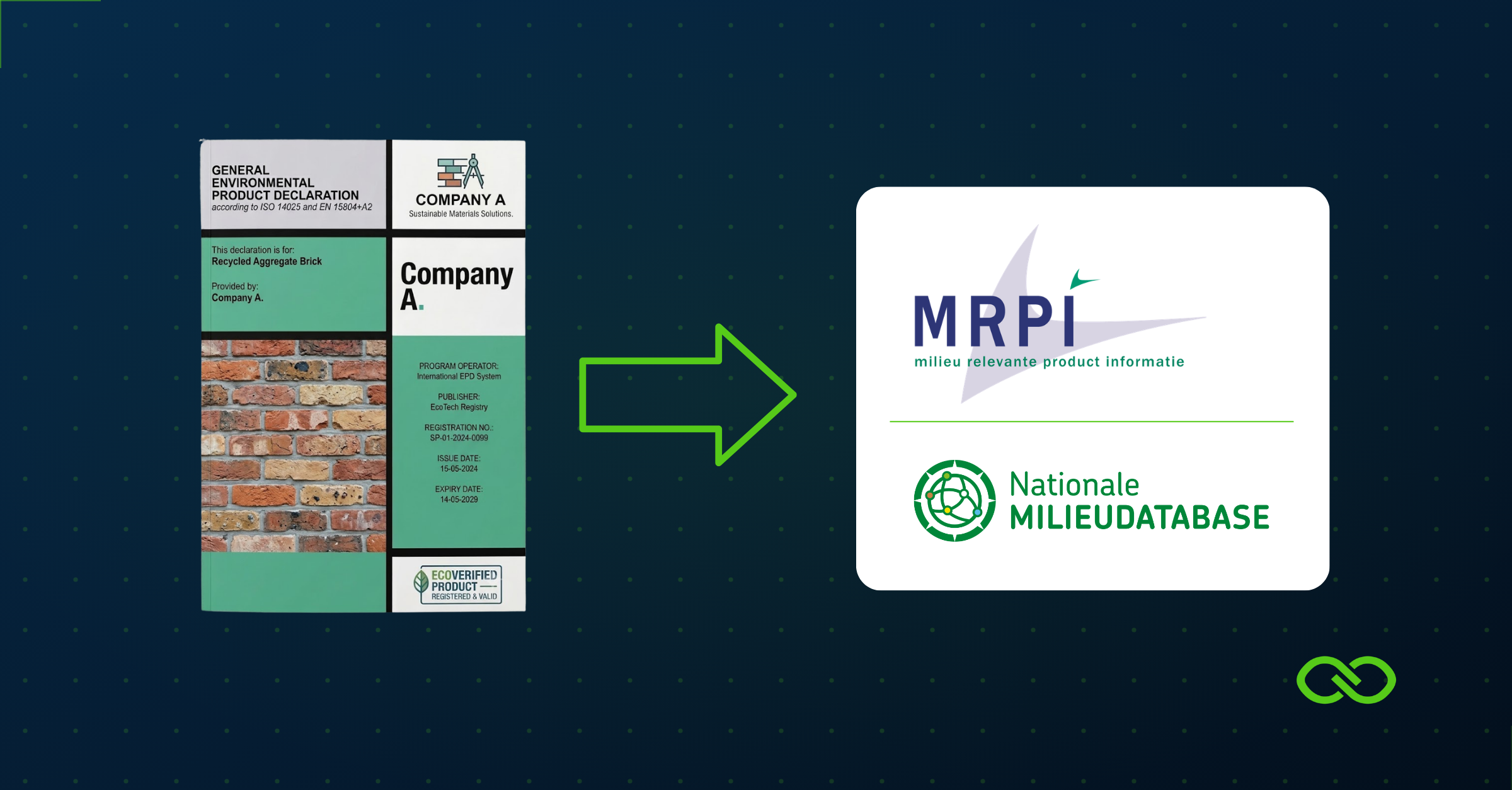
- One route doesn’t feed the other automatically. Publishing through MRPI doesn’t place your product in the NMD, and an NMD entry isn’t the same as a published EPD. They’re separate paths with separate goals.
- The route to either MRPI or NMD is a decision you make before the LCA, not after. It sets which background database, protocol and power mix you work with. If you want both NMD and MRPI, that means ecoinvent 3.9.1 from the start.
- One verified LCA can serve both NMD and MRPI routes and several output formats – if you set the data foundation up for reuse from day one. Ecochain software was built for this reality.
NMD or MRPI: the question that often stalls EPD projects
You’re scoping your first EPD for the Dutch market. The LCA hasn’t started, the data is half-gathered, and someone on the call asks the question that quietly stalls the whole project: do we publish through the Nationale Milieudatabase (NMD), or through MRPI?
It’s a question a lot of manufacturers often reach for too late – after the LCA is already built, when changing course means redoing work.
Ecochain recently ran a webinar on this specific topic, with three experts who together cover the entire Dutch EPD landscape:
- Jan-Willem Groot, Director of the NMD foundation
- Leo Oosterveen, Managing Director of MRPI
- Lex Roes, Senior Environmental Specialist at Ecochain, who guides manufacturers through LCAs and EPDs every day
This FAQ post brings together the most important insights from that conversion and the questions manufacturers ask most about the NMD and MRPI – what each one does, when you need which, and how Ecochain works with both.
1. What are the NMD and MRPI, and what does each one do?
Short version: NMD is a database, MRPI is a publisher. They sit at different points in the same chain.
The NMD (Nationale Milieudatabase) is the national database for environmental data in Dutch construction. It’s the basis for the legal building calculations in the Netherlands – the numbers behind building permits, tenders and several subsidy schemes. Jan-Willem Groot described how broadly it reaches: new build and existing build, the MPG for buildings, the MKI for road and water works, the MIA/Vamil investment schemes, and the WKB quality-assurance law.
Your product data feeds two databases within the NMD: a product database that is used in project tools like Dubocalc, BCI Gebouw, GPR Materiaal and Madaster, and a process database used by LCA software like Ecochain, which then calculate impact at the level of the whole building or civil work (product database) or on the product/functional unit level (process database).
MRPI is a Dutch program operator, founded back in 1999 by the government together with Dutch companies. Its job is to verify and publish environmental product declarations (EPDs) for both the Dutch and the international market. As Leo Oosterveen put it, an EPD is a clear, verified summary of your LCA: the information you want to bring to the market, checked by a third party and published to a standard.
So the NMD holds the data that powers Dutch building calculations, and MRPI publishes your EPD to the wider market. Two different jobs – and most manufacturers end up needing both.
2. NMD vs MRPI: what’s the actual difference?
Here’s the side-by-side, drawn from how Jan-Willem and Leo described each one in the webinar.
| NMD (Nationale Milieudatabase) | MRPI | |
|---|---|---|
| What it is | The national environmental database for Dutch construction | A program operator that publishes EPDs (since 1999) |
| Main role | Feeds the legal building calculations in the Netherlands (MPG for buildings, MKI for civil works) | Verifies and publishes your EPD |
| What you get | Your product recorded in the database, usable in permits, tenders and subsidies | A published EPD – a shareable, verified summary of your LCA |
| Reach | Netherlands (construction) | Netherlands + Europe and worldwide (via Eco Platform) |
| Background database | Fixed by the NMD determination method (currently ecoinvent 3.9.1) | Your choice – you can publish regardless of the database used |
| Verification | NMD test protocol, via recognized NMD verifiers | MRPI General Program Instructions and verification protocol, via MRPI verifiers (many of whom are also NMD verifiers) |
| Best fit | Your product is sold and applied in Dutch construction and needs to show up in building calculations | You want to share detailed environmental data broadly, including beyond the Netherlands |
| One detail that surprises people: there’s a route that bridges both. MRPI offers an MRPI-EPD plus certificate, made in close cooperation with the NMD – the product sits in the NMD and is published via MRPI and Eco Platform, carrying the NMD logo. More on choosing that path in question 5. |
3. Does publishing an EPD via MRPI automatically put it in the NMD?
No, publishing through MRPI does not automatically land your product in the NMD. It also doesn’t work the other way around. As Leo put it plainly: you don’t automatically end up in the NMD – you choose whether you want to.
The reason this matters so much is timing. If you want to be in both, that’s a choice to make very early, ideally before you start the LCA – because the requirements for each route aren’t identical. Decide it up front and you set the LCA up correctly once. Discover it at the end and you may be reworking data to meet a requirement you didn’t plan for.
4. Do I need an MRPI EPD to sell in the Netherlands, or is an NMD entry or environmental profile enough?
Whether you need an MRPI EPD, or whether an NMD entry is enough, comes down to what you’re actually trying to do. Recording your product in the NMD and publishing an EPD serve different goals.
Match your situation to one of these:
- If your product is sold and applied in a Dutch building, it needs to be in the NMD – because it gets recorded in the building permit and used in the MPG calculation. That’s the database side.
- If you want to actively share your environmental data with the market – customers, tenders, comparison – an EPD gives you far more to communicate than a database entry alone. As Lex and Jan-Willem framed it, an EPD carries more information out into the world.
- Some requirements still accept a lighter environmental profile rather than a full EPD. But the bar is moving. Lex gave a concrete example: ProRail used to accept a product profile, and now asks for a verified EPD. The trend is toward more, not less.
So “is an environmental profile enough?” is really “enough for whom?” Check the specific requirement you’re answering – the permit, the tender, the customer – and work back from there.
Continue reading: Which product footprint report do you need? A practical guide to choosing the right LCA output for your business
5. NMD or MRPI: how do I decide which route to take – and why before the LCA?
Whether to go with NMD or MRPI, it’s wise to decide before you brief the LCA, because the route shapes the LCA itself. Settle this at the very start of the project, before you brief the LCA. Ask yourself where you actually need to be. Choose late, and you risk building on assumptions that don’t fit where you want to publish.
A few guidelines that could help:
- Netherlands-only, for building calculations? The NMD route, with a category 1 declaration, may be all you need.
- Broad market reach, including internationally? An EPD published via MRPI (and onward via Eco Platform) gets you there.
- Both? Entirely possible – the parties have agreed how it works together through the MRPI-EPD plus certificate. The catch is that you have to plan for it. To satisfy both, your LCA needs to follow the NMD determination method and the Eco Platform guidelines from the outset, including the right background database.
Leo’s point from the webinar: decide early to prevent disappointment at the end. If you’re unsure which way to go, that’s exactly the conversation to have with your LCA practitioner before any modelling begins.
6. Category 1 vs category 2 in the NMD: can I rely on a trade-association declaration instead of our own LCA?
You can rely on a category 2 declaration – but trade-association membership on its own doesn’t qualify you for one, and that’s the gap a lot of manufacturers miss.
The NMD works with three data categories:
- Category 1 is your own manufacturer-specific data
Category 2 is industry or branch data, and - Category 3 is the NMD’s own generic data used to fill gaps
So where does category 2 actually come from?
As Jan-Willem explained, a category 2 declaration is created when a group of manufacturers sit down together and share their data, producing a kind of averaged picture across those companies. That shared effort is what creates the declaration. Simply paying membership dues to a branch association isn’t the same thing – you participate in a category 2 declaration when you’re part of the group that actually pools the data behind it.
It’s a route that helps the whole sector, too: category 2 declarations help build broader coverage in the database so more construction products and works can be calculated.
7. What’s the fastest route to getting our product into the NMD?
The fastest way to get your products into the NMD is a category 1 declaration, and once your LCA is ready, the route is short. Jan-Willem laid out the 3 steps:
- Get in touch with an LCA practitioner to build the LCA, and an LCA verifier to check it.
- Aim for a category 1 NMD declaration – your own product-specific data.
- Once the basic information is in the LCA and there’s a test agreement under the protocol, your product moves into the NMD quickly through the NMD’s input platform.
What’s changed is the NMD’s own input platform. Getting in used to take more manual work. Now the platform pulls verified data much faster and more automatically, with built-in checks that protect data quality – for example, it works with bandwidths: enter a value outside the expected range and the system flags it before it becomes a problem.
So if your LCA is in good shape, the route in is short. The work sits upstream, in getting that LCA right and LCA automation software like Ecochain helps you get there.
8. Do the NMD and MRPI verification protocols differ – and which background database does each require?
Yes, the NMD and MRPI verification protocols differ – and the background database is the biggest difference between them.
As Leo explains it during the webinar, you can publish via MRPI regardless of which background database you use. The NMD is stricter – its determination method sets the database for you. At the moment that’s ecoinvent 3.9.1. So if you want to publish via both MRPI and the NMD, you have to build your LCA on ecoinvent 3.9.1 from the start.
Two more protocol points worth knowing:
- Power mix: Because MRPI works internationally, it has a more specific protocol for the energy mix – useful if you have a factory in another country with a different power profile. The NMD looks at the Dutch power mix.
- Standardized inputs: Inside the NMD’s determination method, variable data like transport to the construction site is handled with default values – for example, a default 150 km with a defined transport dataset. That keeps the playing field level, so every LCA is set up the same way.
On ecoinvent versions: people often ask why the NMD still uses 3.9.1 when 3.12 exists. Jan-Willem explained the cadence. Every year, the NMD’s technical committee reviews new ecoinvent versions – checking whether each is genuinely better and more complete before adopting it. In practice that means running a version or two behind, then moving up to a stronger database. They’ll review again this year, and inform the market when they switch.
| Good to know: If you’re subscribed to MRPI’s newsletter, you get notified when the program instructions, verification protocol or LCA setup rules change. You can also subscribe to NMD’s newsletter to receive monthly updates on sustainable construction, environmental performance, environmental data, policy, and other relevant news from the Dutch Environmental Database Foundation. |
9. How does the NMD’s method handle recycling and secondary materials (Module D)?
The NMD handles recycling and reuse through Module D, and it’s an area the NMD is actively developing.
In an LCA, the benefit of recycling and reuse lands in Module D. As Lex describes it, Module D is the credit you get back at the end of the life cycle by saving primary material through recycling or reuse. When you recycle parts of a product, that benefit returns in Module D – the last module in the lifecycle – and can be subtracted from your total impact.
There’s a long-running debate here, and the webinar didn’t shy away from it: some manufacturers feel a full LCA can treat secondary materials unfairly through Module D. Jan-Willem was candid that the discussion has been around for a while. What he focused on was what the NMD is doing about it:
- Stimulating reuse and recycling directly in the determination method, including K and H factors that reward both supply-side and non-supply-side reuse.
- A return-guarantee manual, so that when you can credibly declare you’re using recycling or reuse – and a verifier confirms it’s provable – it improves your MKI.
- A connection with Insert, making it easier to see the MKI of a used material versus a new one, which can nudge the market toward recycled materials.
His framing on fairness is worth keeping in mind: the NMD is material-neutral. Every material is measured the same way, on the same method – which, in his view, is the most honest basis for comparison. On the specific worry that using secondary input automatically gives you a lower rating, the session stayed on the developments above rather than a single verdict – a sign this is still evolving.
10. How long is an MRPI EPD valid, and how current must the data underneath it be?
An MRPI EPD is valid for five years. With one important condition Leo flagged: if your environmental performance gets worse compared to what’s in the EPD, you’re expected to update it as a manufacturer. The validity isn’t a licence to let a now-inaccurate figure stand.
The trickier question is the data used in an LCA calculation – an EPD nearly five years old could be built on underlying data that’s closer to ten years old. Lex’s answer: the five-year validity also applies to the data used within an LCA, so in theory those datasets remain usable for five years. In practice, though, an older dataset can become hard to use – for instance, if it was never calculated against the requirements a current MKI calculation expects. Even when the original determination method no longer applies, a dataset can still be used, as long as it connects properly to all the requirements of the new LCA.
The practical takeaway: validity is a date, but usefulness depends on whether the underlying data still meets today’s requirements. Worth checking, not assuming.
11. How long does it take to get a verified EPD for MRPI or the NMD – and will automation make it cheaper?
A verified EPD for MRPI or the NMD can take just a few weeks – as long as your product impact data arrives clean and complete. That timeline is coming down as automation removes manual steps.
As Lex put it, generating the EPD is relatively little work once the LCA is fully verified. Getting to that verified LCA can be a real challenge.
That’s because slow projects aren’t slow because the EPD is hard to produce – they’re slow because something has to go back for rework, sometimes more than once, and those loops stretch weeks into months. Both Leo and Lex pointed to the same bottleneck.
| Continue reading: How to avoid the 11 most common product footprint mistakes on LCA, PCF and EPD projects |
A big part of that comes down to the data you control. Many ERP systems are built for finance and logistics, not environmental data – so the price of a material is in there, but its weight often isn’t. And weight is exactly what you need to build the LCA from primary data. Closing those gaps early is one of the most useful things you can do.
On cost and the “verification on verification” frustration – especially with data from European suppliers – Leo pointed to two things:
- First, reducing errors at the source: catching a mistake the moment it appears, rather than discovering it three steps later.
- Second, the API integration MRPI and Ecochain have built (more on that next), which removes overlapping manual work and the errors that come with it.
Less rework, lower cost.
Knowing the General Program Instructions and verification protocol in advance helps too – you can self-check before a third-party verifier ever sees it, so the review is quick.
12. How does Ecochain work with MRPI and the NMD?
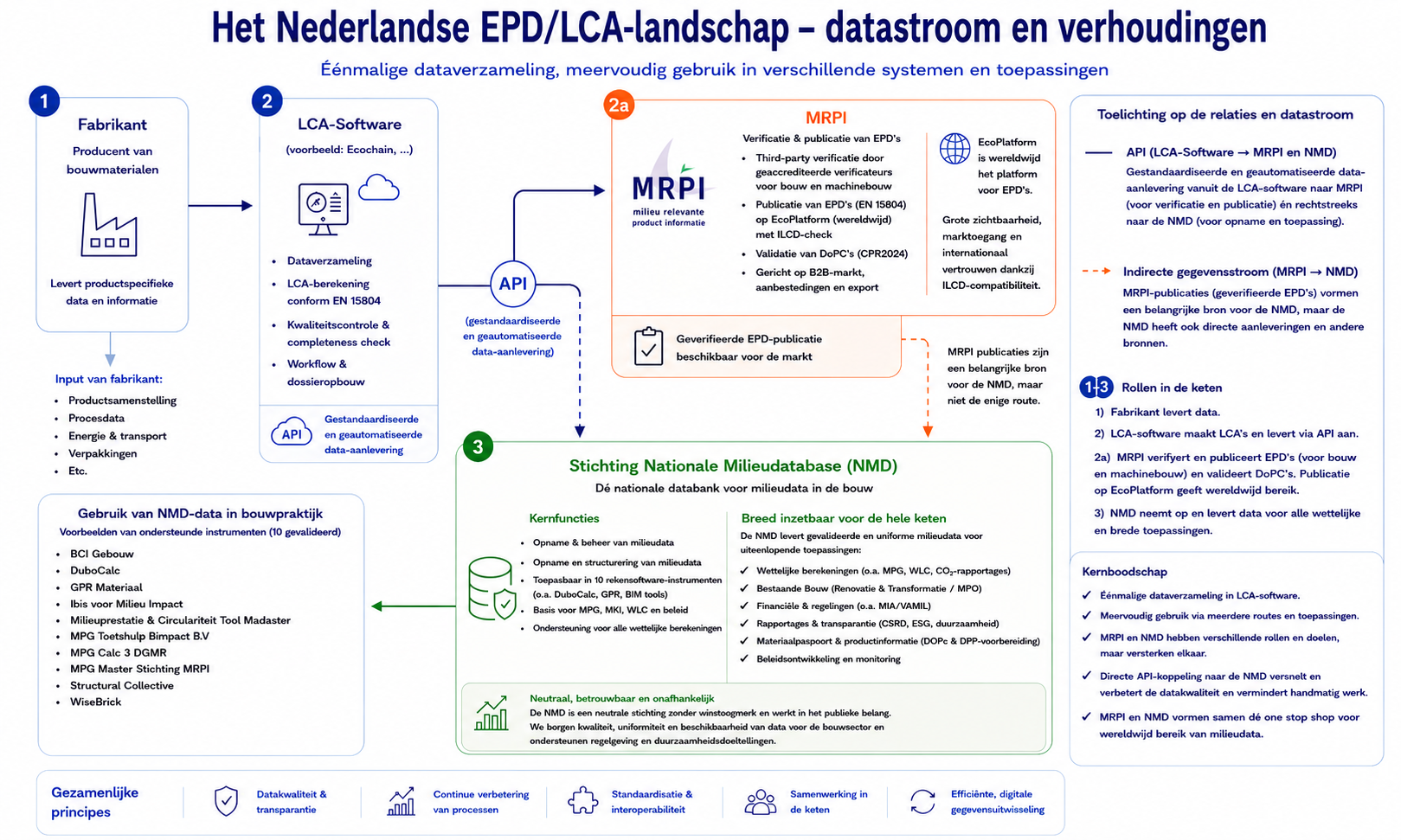
Ecochain works with MRPI and NMD by sitting at the start of the chain – it’s the LCA software where your product data is collected and modelled before anything gets published.Here’s how that looks in practice: A manufacturer collects data – raw materials, energy, production waste, emissions, transport – and Ecochain turns it into an LCA model and calculation. That gets written up in a report, verified, and then it’s ready to publish. From there, the verified result can go to MRPI for an EPD via API, or into the NMD, or both.
Ecochain’s approach to building the LCA is what makes serving multiple routes practical. Rather than calculating one product at a time from the bottom up, Ecochain collects data at company level – energy, transport, materials – and distributes it across every process and product. That models your whole portfolio in one go, using activity-based footprinting. It’s the difference between a single-product model and verification, where all the effort goes into one product at a higher cost, and a mass verification that covers your portfolio with the same assumptions at a much lower cost per product.
When you build an LCA for the NMD route, it draws on the NMD’s own process database – industry background data (energy, transport, waste processing, based on ecoinvent) that keeps every Dutch construction LCA on a common basis. The MKI and MPG themselves aren’t produced by the LCA software. They’re calculated by the calculation instruments (MRPI is one) at building or civil-work level, using that data.
So in plain terms: Ecochain is where the LCA is calculated. MRPI and the NMD are where it goes. The software is built to feed both.
13. Can you publish to both MRPI and the NMD from one LCA in Ecochain?
Yes. One verified LCA in Ecochain can feed both routes – which is exactly where the double work disappears.
A verified LCA built in Ecochain can produce several outputs from one data foundation: an EPD, an environmental profile, a product carbon footprint, in formats like PDF, XLSX and Word. Because the model is set up once and reused, you’re not starting from zero each time a different route or customer asks for a different format.
On the connection itself, Ecochain and MRPI have built a live API integration: the LCA data you create in Ecochain flows directly into MRPI’s system, with no overlapping manual re-entry. The system auto-generates the control sheet and the EPD PDF, and the third-party verifier receives all the data directly. The first tests were set for early July, followed by a pilot with one manufacturer covering 70+ EPDs, then a wider rollout in the second half of the year. A connection with the NMD is on the roadmap, and the NMD and MRPI are working out how to exchange data between their two systems as well.
For the MRPI-EPD plus route specifically, this is the practical payoff: one LCA, built to the right method and database from the start, can land your product in the NMD and publish your EPD broadly through MRPI – without building it twice.
One LCA foundation for both NMD and MRPI, inside Ecochain software
The hard part of publishing environmental data isn’t choosing between the NMD and MRPI. It’s everything upstream: getting clean data, building a verified LCA, and not having to redo it every time a new route, format or market comes along.
That’s the case for setting your data foundation up properly once. When the LCA is right and reusable, the NMD entry, the MRPI EPD, the international publication and the formats your customers ask for all come from the same source – and the choice between routes stops being a fork in the road and becomes a setting you flip.
The software you use for that work matters precisely because it sits at the start of the chain. Ecochain models your portfolio once, works directly with MRPI through a live API integration (also has the NMD connection on its roadmap), and produces your outputs in multiple formats for multiple program operators. The goal is less rework, fewer errors, and one foundation you can keep building on as regulation keeps moving – the CPR, CSRD, and the shift toward the DoPC and Digital Product Passport.
See how Ecochain helps manufacturers publish EPDs to MRPI and the NMD from a single LCA →