Summary (TL;DR) of what this blog covers
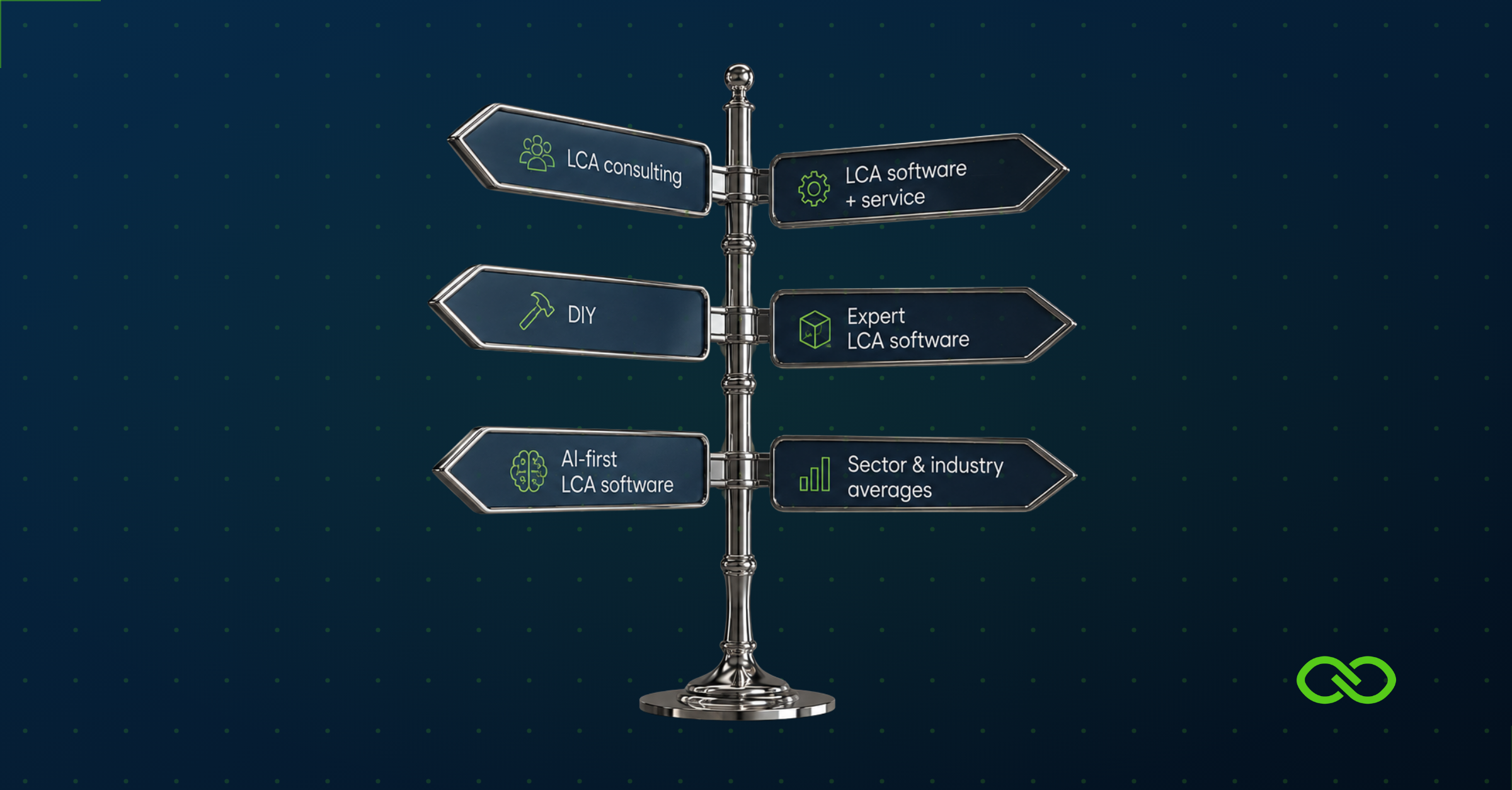
- Manufacturers often calculate product footprints in one of six ways: using generic or sector-average data, outsourcing to an LCA consultancy, buying AI-first software, investing in expert LCA software that needs an in-house specialist on payroll, buying LCA automation software combined with expert service, or taking a DIY approach with spreadsheets.
- Sustainability and product teams often settle on one approach that becomes the default for years, long after it stopped serving them. What decides whether you chose the best approach for your business is whether you repeat the work every time. That comes down to what you keep at the end: a one-off product footprint report you can’t adjust or reuse, or a model you can update and reuse for multiple requests.
- This guide is about the pros and cons of each approach and when each one fits, rather than methodology choices like system boundaries or impact assessment methods. It also includes 12 questions to ask before you decide on your product footprinting approach.
How manufacturers end up choosing a way to calculate product footprints
Very few sustainability managers evaluate six options and pick one.
What usually happens is that a request lands with a deadline attached. It might be a construction tender asking for a verified EPD. It might be an OEM customer sending a Scope 3 questionnaire, a retailer asking for carbon data before a listing decision, an R&D team wanting to compare two materials, or a regulatory deadline under CPR or ESPR that someone has just noticed. Sometimes it’s a single large customer who has decided their suppliers need product-level data by Q3.
| New to the terminology? Start with the difference between LCA, EPD, PCF and DPP |
Whatever triggered it, it’s normal to reach for whatever gets you the number in time. For most teams that becomes the default, and two years on you’re still using it – even though the market has moved, your business has grown, and the portfolio you now need footprints for is far bigger than it was.
Choosing the right option comes down to being realistic about your in-house resources and needs, how many product footprint requests you expect over the next two to three years, and whether you can afford to start from scratch each time.
Below we outline six ways to calculate the environmental footprint of what you manufacture, with the pros and cons of each, how they work in practice, and when each one works best.
Quick comparison: 6 ways to get your product footprints calculated
| Approach | Who it suits | When to choose it | Pros | Cons |
|---|---|---|---|---|
| 1. LCA consultancy | Best for teams that need expert-led, defensible LCA results for complex products or one-off studies without building specialist capability in-house. | The product is unusually complex. You need expert judgment and a credible study without building internal capability or a repeatable system. You have a budget of approx. €5,000–€10,000 per product footprint. | You get strong outsourced expertise (no internal capability needed). You get someone who can handle difficult methodology choices. Less internal burden. | The model usually stays with the consultancy so you have no control over data and results. Costly (can get into million ranges for big portfolios). Slower than software-led workflows for short-notice requests. Limited scalability across many products. |
| 2. Expert LCA software with in-house specialist (e.g., OpenLCA, SimaPro, Sphera) | Best for teams that need maximum methodological control and have an experienced LCA practitioner to build and manage the calculations in-house. | You perform LCAs regularly, use advanced or unusual methodologies, and need full control over assumptions and models. | Maximum control. Transparent assumptions. Strong for advanced work. | Requires specialized LCA expertise and internal data ownership. Setup takes time. Resource-intensive (becomes a headcount decision). Can become a bottleneck if one person owns everything. |
| 3. LCA automation software with on-demand expert service (e.g., Ecochain) | Best for teams that want scalable product footprinting with full in-house ownership, without having to build everything themselves or outsource every update to a consultancy. | You have recurring calculations across multiple products and want a reusable model with expert support when questions or methodology decisions arise. | Reusable model. Your business runs it in-house after setup. Efficient for recurring calculations. Combines software speed with expert review. Verification support built in (with Ecochain). | Requires data ownership by your business. Best value comes with ongoing volume. Over-built for a single one-off EPD. |
| 4. AI-first LCA software | Best for teams that want rapid early-stage estimates before investing in a more accurate LCA work. | You need to compare options quickly, identify hotspots, or decide which products require a deeper assessment. | Very fast. Helps prioritize which products need full LCAs. Can cover many SKUs. | Often hallucinated and unverified data. Hard to validate. Impact categories apart from carbon are not always supported. Rarely accepted by verifiers. Weak basis for an external claim. |
| 5. Generic or sector-average data | Best for teams that need a quick directional estimate before product-specific data or budget is available. | A deadline is close, product data is missing, and the result will only guide an early decision. | Fast to access, low effort, useful for first-pass estimates | Low accuracy for product decisions. Weak for claims or audits. Not suitable when product-specific data matters and erases any advantage your product has. Not maintainable long term. |
| 6. DIY using spreadsheets (e.g., Excel or Google Sheets) | Best for teams that need a low-cost, flexible way to build simple internal calculations and already have the time and LCA knowledge to manage them. | The scope is limited, the calculation is for internal use, you can accept the extra effort required for checking and maintenance, and you’re comfortable building the formulas. | No software licence or consultancy cost. Every formula is visible and data control stays with you. No vendor dependency. | Usually only the author understands the file. Updates are manual and the risk of errors is high. Hard to audit. Poor scalability. Difficult to verify or standardize. |
Approach 1: Outsourcing product footprint calculations to an LCA consultancy – best for one-off deep studies and complex products
Outsourcing to an LCA consultancy means an external team runs the assessment for you. They collect data with your staff, make the methodology decisions, sometimes even manage the verifier relationship, and deliver a finished study or published EPD.
Your team supplies production data, answers questions and reviews the results. The consultancy provides the specialist expertise, software and modelling capacity.
How it works in practice
You brief the consultancy on the product, intended use and standard or programme you need to meet. They send a data request, usually covering materials, energy, transport, packaging, manufacturing processes and waste.
Your team collects and provides the data, often over several weeks. The consultancy then asks follow-up questions, builds the product system, selects background datasets, applies allocation rules and calculates the environmental impacts.
If you need an EPD, the consultancy may also coordinate the verification and programme operator submission. Once the process is complete, you receive the study, EPD or other agreed output.
For products with long bills of materials, multi-stage process chemistry or difficult allocation questions, this can be a practical route to a defensible result. You are buying external expert judgement and delivery capacity rather than building that capability yourself.
Best for
Teams that need expert-led, defensible results for complex products or one-off studies without building specialist capability in-house. It suits companies with a small number of high-value products, an unusual methodology question, or a specific customer, tender or compliance requirement. A consultancy is also a sensible way to complete a first EPD and understand what a robust process looks like before deciding how to scale.
On budget, expect roughly €5,000–€10,000 per product footprint. The exact cost depends on the product, data quality, scope, number of products, required impact categories, and verification and publication requirements, so treat the range as an indication rather than a standard market price.
Where it falls short
The LCA model, assumptions and calculation structure may remain with the consultancy. You receive the output, but you may not receive a reusable model your own team can update. This depends on the contract, so it is worth asking in advance:
- Who owns the model and underlying files?
- Which software and databases were used?
- Can your team access and reuse the model?
- What happens when a material, supplier or manufacturing process changes?
- What will future updates cost?
This becomes especially important as your portfolio grows, because total cost tends to track portfolio size fairly closely when nothing carries over between studies.
Here are 4 specific examples from our recent conversations with manufacturers that might help you understand where LCA consultancy can fall short:
- One US manufacturer described a consultant-led EPD process running 12 to 18 months at roughly $11,000 per EPD, which was delaying product launches and costing them federal project bids
- A UK B2B manufacturer was spending around £22,000 a year to get about seven product footprints, delivered via manual spreadsheet packs
- One manufacturer told us they ended up with three separate consultants covering three product lines, and described the reports coming back as black boxes
- One chemicals company had to correct heat and mass balance errors in EPDs that a consultancy had produced and invoiced for
None of this makes consultancies a bad choice. But it can make them a poor fit for volume or data control. They excel at complexity and judgement-heavy work, and they struggle when what you need is repeatability across dozens or hundreds of products.
Approach 2: Expert LCA software with an in-house sustainability specialist – best for full methodological control in expert hands
Expert LCA software gives a trained practitioner detailed control over how a life cycle assessment is built. Tools such as SimaPro, openLCA and Sphera let users make their own decisions about system boundaries, allocation methods, impact assessment methods and background databases. These tools can be too complex for sustainability professionals with no LCA expertise.
How it works in practice
You licence the software and your LCA practitioner builds the product system from the ground up. Rather than filling in a template, they construct a network of unit processes – each material input, energy flow, transport leg and waste stream modelled separately and linked by flows.
Every input gets a background dataset chosen by hand. For one steel component that means deciding which ecoinvent dataset applies and which system model it comes from: cut-off, APOS or consequential.
The same applies downstream. They select the impact assessment method – ReCiPe 2016, EF 3.1, CML or IPCC GWP100 – and decide whether to normalize and weight. They set allocation process by process, choosing between mass, economic value, energy content or system expansion wherever something produces more than one output.
They can also run Monte Carlo simulations across parameter distributions to check whether the gap between two design options is real or sits inside the noise.
Finally, interpretation under ISO 14044: contribution analysis, completeness and consistency checks, and the documentation a critical reviewer will ask for.
Best for
Teams that need maximum methodological control and have an experienced LCA practitioner to build and manage the calculations in-house. It suits research-grade work, unusual methodologies and high volumes of genuinely complex assessments, and it fits organizations that want to retain the models, expertise and decision-making capability internally. That means having an LCA specialist in place already, or a clear business case for hiring or training one.
Where it falls short
The software is designed for LCA practitioners, not for a sustainability professional or product manager who also owns supplier questionnaires, customer requests, the annual report, as well as CSRD and other regulatory reporting. Buying a powerful tool without the expertise and time to use it properly can leave you with a costly system only a small part of the organization can operate.
The decision is therefore about capability as much as procurement. Questions worth answering before you buy:
- Can you justify a dedicated LCA specialist?
- Is there enough recurring work to keep that person productive?
- Who will maintain the models and datasets?
- What happens to the capability if that person leaves?
- Can product, procurement and operations teams supply the data required?
Without the expertise already in place, the investment covers both the software and the people needed to operate it.
| If you’re weighing specific tools, the LCA software buyer’s guide walks through what to look for in your next Life Cycle Assessment software, when each thing matters, 8 red flags to watch for and 12 questions that tend to expose how a tool really behaves once you’re past the demo. |
Approach 3: LCA automation software with expert service embedded – best for recurring product footprint outputs across a portfolio
LCA automation software is built for the person who owns sustainability day to day rather than for a trained LCA practitioner. It standardizes and automates parts of the modelling, calculation and reporting process, so the work becomes more about organizing data and interpreting results than constructing every model from scratch. When LCA software is paired with expert service, as in Ecochain’s case, environmental specialists help set up the data foundation, support methodology decisions, train the team and stay available when more complex questions arise.
How it works in practice
Let’s take Ecochain as an example.
You start with the software. The first real work is data collection, pulling bills of materials, supplier data, energy use and process information out of your ERP, your production floor and your suppliers‘ inboxes. This is the slow part of any LCA, and no tool removes it.
From that data you build the foundation. Materials get mapped to background datasets, processes get defined, facility-level energy and waste get allocated to products, and you settle on the methodology available in the software and system boundaries you’ll apply across the portfolio. Once that exists, the software uses the LCA engine to do the calculations and the model is yours to edit.
You can do this yourself or with Ecochain’s LCA specialists. Manufacturing companies with in-house LCA professionals sometimes prefer to model themselves and bring in our experts only for specific questions. Sustainability and product teams doing LCAs for the first time, or for example working under a tender deadline, tend to have our experts do the modelling and methodology choices with them, then take over once the structure is in place. Both routes end in the same place, with a model your team owns.
Once the foundation exists, the second product is far quicker than the first, and so are the tenth and the hundredth. A new product variant usually means changing inputs on a model that already exists. A new output, whether that’s a PCF, an EPD or a hotspot analysis for R&D, runs on the same underlying structure and the same documented methodology, so results stay comparable across your portfolio and facilities. The bigger the portfolio, the more that setup work pays back.
One important note: Depending on what an output is used for, it may still need internal review or third-party verification. LCA automation software with expert support makes that path more predictable with verifiable results you could submit with program operators like MRPI, IBU, NMD and more.
Best for
Sustainability and product teams without LCA expertise that want scalable, cost-effective product footprinting in-house without outsourcing every update to a consultancy. It suits manufacturers with recurring footprint requests across a portfolio who want the results and the data model to stay in-house but do not have a dedicated LCA specialist on payroll. Construction product manufacturers facing recurring EPD, tender or customer requests, and industrial manufacturers answering repeated product carbon footprint requests, both tend to land here.
LCA automation software with expert service works when you are prepared to assign internal ownership for data collection and review, and it becomes more valuable as the number of products, variants and recurring requests increases.
Where it falls short
Somebody on your side has to own the data. If nobody has time to pull production figures, check bills of materials or chase suppliers, setup stalls regardless of how much expert support sits behind the LCA software.
It also asks more of you than fully outsourced LCA consultancy. You are building internal capability rather than buying a finished document, which means your team needs time for setup, training, data collection, review and ongoing maintenance before the efficiency benefits appear.
The approach is not suitable for everyone:
- If you need one EPD once and have no follow-on work, the setup may be more infrastructure than the problem requires
- If you already employ an LCA specialist who is productive in expert software like SimaPro, you may not need an automation-led LCA approach
| Ecochain is one example of this approach. The software handles the modelling, calculation and reporting mechanics, and our LCA specialists set up your data foundation with you, train your team, and stay available for any and all questions that come up along the way. We work mainly with industrial manufacturers in Benelux and DACH, and publish through EPD Global, NMD, MRPI, EPD International and IBU.
Book a demo to walk together through your portfolio and explore if LCA software with expert services is the right approach for your business. If one of the other five approaches fits you better, we will say so. |
Approach 4: AI-first LCA software – best for screening a large portfolio quickly
AI-first LCA software uses machine learning or other automated estimation techniques to fill gaps in inventory data. You provide a bill of materials, product specification or product description, and the tool estimates missing inputs by matching them with similar products, materials or processes in its reference data. The result is a modelled estimate, not a measurement of your exact production process, and the quality of the output depends on the data, assumptions and reference datasets the tool uses.
How it works in practice
You upload product data, usually a BOM, specification or list of materials. The tool maps the inputs to its own reference datasets, infers missing information and produces impact figures for the categories it supports.
You can then compare products, identify likely hotspots and rank your portfolio. A sustainability team with 400 SKUs could use the results to find the products most likely to benefit from improved material data, supplier engagement or eco-design work.
The output should be treated as a screening result or working hypothesis. It can help answer „where should we focus first?“ but does not automatically answer „what is the verified footprint of this product?“
Best for
Teams that don’t want verified declarations or accurate public claims, but instead want rapid early-stage estimates and hotspot insights across many products before investing in detailed LCA work. It suits portfolio screening, early eco-design comparisons and deciding where to spend a limited assessment budget, and it can help product teams compare design directions before all supplier and process data is available.
Where it falls short
Validation and traceability are the main challenges with using AI-first LCA software. Environmental impact results rarely have one simple ground-truth value, so the quality of an AI-generated estimate depends on the quality of the source data, the similarity of the reference products and the assumptions made when information is missing.
That may be acceptable when ranking your own products against one another. It becomes more difficult when a verifier, customer or regulator asks you to explain exactly where a specific number came from.
Before adopting an AI-first LCA tool, ask:
- Which data sources and databases does it use?
- Which inputs are measured, supplied or estimated?
- Can you see and edit the assumptions?
- Are the calculations reproducible?
- Can the results be exported into a transparent, reviewable model?
- Is the tool intended for screening, or can it support a formal verified study?
AI-first LCA software vendors will argue that statistical inference beats the rough assumptions a person would otherwise make, and they have a fair point. The question to put to them is what happens when the number needs to be defended.
Approach 5: Using generic or sector-average product footprint data – best for answering a request you have no budget for
Using generic or sector-average data means reporting environmental figures calculated for a product category resembling yours, rather than assessing your own product. The data may come from a trade association’s sector EPD, a public database, a supplier’s published declaration, or default values built into a national calculation method. You are still doing a calculation, but you are not modelling your specific product system or your actual production process.
How it works in practice
A request arrives on Tuesday for environmental data on a product never assessed before, and it closes on Friday. So you look for numbers that already exist:
- A sector EPD published by your trade association
- A generic figure from a public database for the nearest product category
- A supplier’s published EPD for an input material or component, where using it as a proxy is methodologically appropriate
- A published EPD for a comparable product, where the applicable rules permit the comparison or proxy
- A rough spreadsheet built from public emission factors when nothing else fits
You then provide the figure with a clear explanation, such as: „Based on generic industry data for [category]. Product-specific data is not yet available and is under development.“
This may take only half a day and can help you respond quickly. The important thing is to distinguish clearly between generic data, proxy data and product-specific verified data. They are not interchangeable, and a customer, verifier or programme operator may treat them differently.
Best fit
Teams that need a quick directional estimate before product-specific data or sustainability budget is available. It fits a short deadline, an initial tender response, early screening, or a figure supporting an internal decision rather than a formal external claim – provided it is clearly labelled as generic.
It is also a practical way to decide whether a product deserves a deeper assessment.
Where it falls short
Generic and sector-average data can make a product look worse or simply less differentiated than it actually is. Improvements such as lower-carbon energy, increased recycled content, material reduction or reformulation may not be reflected in an industry-average figure. To a specifier comparing products, yours can look no better than the market average even when its actual impact is lower.
This has practical consequences in construction markets where generic data receives a conservative adjustment, or where product-specific declarations are preferred:
- The Netherlands: The Dutch National Environmental Database (NMD) distinguishes between product-specific verified data (Category 1), industry- or sector-specific verified data (Category 2), and generic Category 3 data. Category 3 data carries a 30% markup factor so if a specifier uses Category 3 data in an MPG calculation, the generic dataset can therefore make the product’s environmental performance appear worse than the underlying estimate.
- France: Under RE2020, when no FDES exists for a product, the calculation falls back to Données Environnementales par Défaut. These are deliberately overestimated, carrying roughly a 30% increase on the indicators, and the stated purpose is to push manufacturers to publish real FDES.
- Germany: Generic Ökobaudat datasets used in QNG assessments carry a safety surcharge applied under worst-case assumptions. The sharper issue is that QNG currently offers no route to reflect the environmental advantages of choosing a specific product at all.
Beyond the arithmetic, a tender, customer or building assessment may specifically request a manufacturer-specific verified EPD or another approved form of product data. Generic data may score less favourably, may not show your product’s actual improvements, or may not meet the evidence requirements for the intended use. Under the revised CPR, environmental declarations feed into your Declaration of Performance and Conformity, and a branch average may not be accepted as equivalent evidence.
Most manufacturers start here, and there is nothing wrong with that. Generic data has a legitimate role as an interim step. The risk is treating it as the destination for all future requests.
Approach 6: DIY using spreadsheets – best for when you have the expertise, the time and no budget
Building your product footprint in Excel or Google Sheets means constructing the calculation by hand. Product inputs and quantities go in one sheet, emission or characterization factors in another, and formulas connect them. You source the factors yourself, set the system boundary, handle allocation manually and interpret the results. Nothing is automated, and nothing is checked for you.
How it works in practice
You start with the bill of materials. Each material receives a mass, and each mass is multiplied by an appropriate emission or characterization factor. You then add energy use per unit produced, transport distances and modes, packaging, manufacturing losses and waste treatment.
The results are summed by the life cycle stage to produce, for example, a cradle-to-gate product carbon footprint.
Factors may come from a licensed database, public datasets or industry-specific sources. You need to record the source, version, geography, year and unit for every factor. Keeping them current is a manual task each time a database or methodology changes.
Some industry associations publish sector calculators using this type of structure. These can be useful starting points if the scope, factors and calculation rules suit your product category.
Best for
Teams where someone already knows LCA methodology, there is no budget, and there is enough time to do the work properly. It suits internal screening, early hotspot analysis and a first-pass PCF on a straightforward product. It is most appropriate when the number of products, users and impact categories is small, and it is also a genuinely good way to learn how the calculation behaves before you decide what to buy, because nothing is hidden from you.
Where it falls short
Auditability is the main constraint. To use the data externally or have it verified by a third party, you need to show how you reached the number: the factor version, data sources, allocation choices, system boundary, assumptions and any exclusions.
A spreadsheet can hold all of that, and keeping it complete and consistent over time is difficult. Spreadsheet work tends to struggle at verification for two reasons: the calculation cannot be independently reproduced, and the supporting evidence is incomplete or hard to trace.
Also, multiple impact categories become difficult quickly. A carbon footprint may require one set of emission factors. An environmental declaration under a standard such as EN 15804+A2 requires consistent characterization across multiple mandatory indicators, life cycle modules and data-quality requirements.
There is also a clear people risk. The file may make perfect sense to the person who built it and not to whoever inherits it. When the owner goes on holiday or leaves, the practical answer is often to rebuild the calculation.
Scaling creates another problem. Product two means copying and editing the first file. By product twenty you may have multiple versions with different factors, formulas and assumptions that have gradually drifted apart.
In general, using spreadsheets for product footprinting is useful for learning, screening and simple internal calculations. They are a weak foundation for a portfolio-wide footprinting process unless you invest heavily in documentation, version control, review procedures and data governance. Where they stop being the right tool is anything going to a verifier, a programme operator or a tender committee.
12 questions to ask before you commit to a product footprinting approach
The best approach for calculating your product footprints isn’t always the most advanced one. It’s the one that gives you a result fit for its purpose, repeats easily enough for your workload and stays manageable for the people who’ll own it.
Before you commit, go through these questions for the approach you’re considering.
Scope and repetition
- How often will you need to repeat the calculation? Once for a tender, or every quarter as production shifts?
- What happens when a product changes? A supplier switch, a recipe change or a new energy contract shouldn’t mean starting over.
- How many products will you need to cover in two years, and does the approach scale to that number?
Reuse and outputs
- Do you need the model to feed multiple outputs, like an EPD, a PCF, a customer questionnaire and an R&D comparison?
- Will results stay comparable across products, or does each calculation stand alone?
- Do outputs need third-party verification, and does the approach support that path?
Data and traceability
- Will you need to explain where the numbers came from, to a verifier, a customer or an auditor?
- Can you see the assumptions, background datasets and system boundaries behind a result, or only the result itself?
Ownership and continuity
- Do you have someone in house who’ll own the data and keep it current, and how much of their time does that take?
- Do you want something that stays inside your company, or are you comfortable outsourcing it completely?
- What happens when the person managing the model leaves? If the answer is „we’d have to rebuild it,“ that’s worth knowing now.
- If you switch providers in three years, what do you keep?
Most of these questions only get answered honestly after the first calculation is done, which is exactly when the answers are expensive to change. Working through them upfront costs an afternoon.
There’s no single right answer here. A manufacturer with eight products and one tender a year has a different situation to one with a 400-SKU catalogue and customers asking for footprint data every month. The approach that fits the first would slow the second down, and the reverse is just as true.
What’s worth being deliberate about is the part that’s hardest to reverse. Whoever ends up holding your model, your data and your methodology decisions is who you’ll depend on every time something changes.
Frequently asked questions about life cycle assessment approaches
What business approaches can I explore to calculate the product footprint for my manufacturing business?
Manufacturers can choose from six main approaches when deciding how to calculate the environmental impact of their products: a) using generic or sector-average data for quick directional estimates; b) outsourcing a complex or one-off study to an LCA consultancy; c) using AI-first LCA software for rapid portfolio screening; d) using expert LCA software with an in-house LCA specialist for maximum methodological control; e) using LCA automation software with expert support, such as Ecochain, for recurring product footprinting across a portfolio; or f) building simple internal calculations in spreadsheets when the scope, expertise and budget are limited. The right approach depends on the required level of accuracy and verification, the number of products and updates involved, the complexity of the products, and who will own the data and calculations over time.
What is the cheapest way to calculate a product’s carbon footprint?
The cheapest approach to calculating your product’s footprint is usually to use generic or sector-average data, or to build a simple calculation in a spreadsheet using public emission factors. These options can work for early internal screening when you have limited budget, time and product-specific data, but they provide less accuracy, scalability and auditability. AI-first LCA software may offer a relatively low-cost way to screen many products but you have to be careful about the accuracy of these results, while a consultancy, expert LCA software or LCA automation software with expert support is more appropriate when the footprint must be product-specific, repeatable, externally reviewed or used for an EPD, tender or customer claim. The cheapest option is therefore not always the most cost-effective one for recurring or externally scrutinized footprinting.
How much does it cost to work with an LCA consultancy?
How much it costs to work with an LCA consultancy varies widely by product complexity and market. For reference points from manufacturers we’ve spoken to: one US company reported roughly $11,000 per EPD with a 12 to 18 month turnaround, and a UK manufacturer was spending around £22,000 a year for about seven product footprints. The more useful point is how cost behaves rather than where it starts. Because the model stays with the consultancy, cost scales roughly in line with the number of products assessed.
Can I do a life cycle assessment in Excel?
You can build a rough product carbon footprint in Excel or Google Sheets for a simple product, and many manufacturers use spreadsheets for internal screening. A full LCA across multiple impact categories – such as one prepared under EN 15804+A2 – is more demanding, not because Excel cannot perform the calculations, but because you must manage the datasets, system boundaries, allocation choices, assumptions and documentation yourself. For an externally reviewed or verified result, a verifier needs to trace how each figure was calculated and which factor versions and assumptions were used. That evidence can become difficult to maintain in a spreadsheet built up over time, particularly when one person owns the file.
Is AI-generated LCA data accepted by verifiers?
AI-generated LCA data is generally not accepted as the basis for a verified EPD. The obstacle is validation rather than speed. Most environmental impact measures lack a single accepted ground-truth value, so the accuracy of a machine-learning estimate gets inferred from proxy metrics or expert judgment rather than tested directly. That works for internal screening and for comparing your own products against each other. It’s hard to defend when a verifier asks where a specific figure came from.
Do I need to hire an LCA expert to use LCA software?
Whether you need to hire an LCA expert or not, depends on the software. SimaPro, openLCA and Sphera expose full methodological control and realistically need a practitioner. LCA automation software like Ecochain built for sustainability professionals at manufacturing companies doesn’t, though someone internal still has to own data collection. No tool solves the problem of getting production and supplier data out of your own organization.
Can I switch LCA approaches later from a consultancy to LCA software?
Most manufacturers switch LCA approaches at some point, usually moving from generic data or a consultancy toward LCA software like Ecochain with a reusable foundation once request volume climbs. Switching is easier when your underlying data is already structured and documented. If what you have is a consultancy report plus an undocumented spreadsheet, you’re largely starting again. Asking a consultancy up front whether you’ll receive the model as well as the report makes a later move considerably easier.