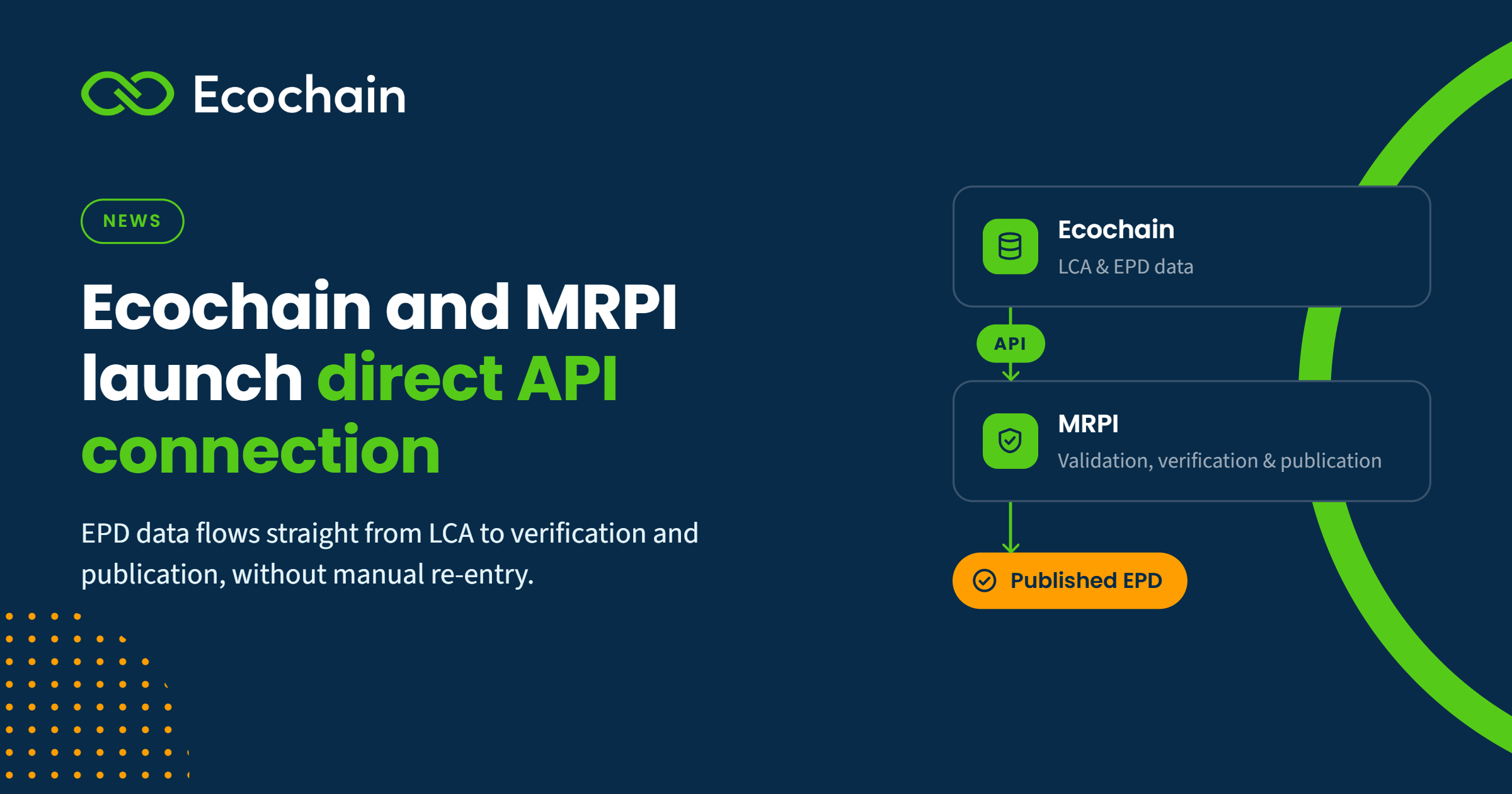
Ecochain and MRPI have built a direct API connection that sends data for EPDs from the Ecochain platform straight into MRPI’s verification and publication system, with no manual re-entry. Ecochain is the first solution to build this API for MRPI and the first truly end-to-end solution for EPDs in the Netherlands.
The two organisations presented the API on 6 October 2026 at Verbinding in data (“Connecting through data”), an afternoon on APIs and environmental data links co-hosted with the Stichting Nationale Milieudatabase (NMD) at Koninklijke Metaalunie in Nieuwegein.
Data flows straight from Ecochain to MRPI
Until now, publishing an EPD with MRPI meant exporting data from LCA software and uploading it separately into MRPI’s system. With the new connection, structured LCA and EPD data travels directly from Ecochain to MRPI. MRPI validates it, tracks its status and keeps a full audit trail.
The route from calculation to publication now runs in four steps:
- Ecochain holds the manufacturer’s structured LCA and EPD data.
- The API connection sends that data to MRPI in one action.
- The MRPI platform validates the data, tracks its status and logs every step.
- EPD publication follows after independent review and verification.
Hannah Doff-Ottens, CPO of Ecochain, showed the audience how it works. Users connect MRPI once in the software, select the products to publish and add study-wide details such as methods, market and images. Product-level changes are possible, and a validation check confirms that everything MRPI needs is in place before anything is sent.
After a first test in early July, the link went fully live in MRPI’s production environment in the week of the event. A pilot with 75 EPDs from a single manufacturer is next. “This is really the highlight of today,” said Leo Oosterveen, Managing Director of MRPI. “It works.”
Verification stays with people
The API automates the data transfer, not the judgement. Every EPD still has one named LCA expert and a verifier, and the verifier must approve it before MRPI publishes. MRPI also checks each submission against its digital data requirements, and an auditor re-checks 1% of EPDs as part of MRPI’s ECO Platform oversight. Leo underlined the point with a slide from a 1979 IBM training: “A computer can never be held accountable.”
What it means for manufacturers
For manufacturers, the connection means EPD data is entered once and reused, instead of being retyped for each step towards publication.
- No more re-entry. Data modelled in Ecochain goes to MRPI as it is, so manual input and copy-paste from spreadsheets drop out of this route.
- Fewer errors. Leo recalled MRPI staff spending days hunting for mistakes in Excel files where one added column had shifted all the data. A direct system-to-system link removes that kind of error.
- Faster to market. Fewer hand-offs shorten the path from a finished LCA to a verified, published EPD, which counts when a tender deadline is close.
- Built for volume. The link is designed for large numbers of EPDs. Combined with Ecochain’s mass verification, where a whole product family is verified in one go, the cost per EPD goes down.
- Checked before it is sent. Ecochain validates the data against MRPI’s requirements before submission, so gaps are caught early.
- Always in view. Status updates from MRPI flow back into Ecochain, and MRPI’s audit trail records every step.
- One dataset, wider reach. Verified MRPI EPDs can be published worldwide via ECO Platform, and data MRPI publishes can in turn be retrieved by others through an API.
The timing matters. EPDs are increasingly required in public tenders, for example by ProRail and Rijkswaterstaat, and the CPR, CSRD and the Digital Product Passport are making environmental data part of standard product information.
Verbinding in data: one data chain, three perspectives
The afternoon brought manufacturers, LCA practitioners, verifiers and calculation-tool providers together around one idea: collect product data once, use it many times. Each host covered its own link in that chain.
Ecochain: from impact data to business value
Hannah Doff-Ottens opened with why demand for product impact data keeps growing: tenders, customers further down the supply chain, regulation and companies’ own reduction targets. Ecochain’s vision responds to exactly that: impact data becomes as routine as cost and quality data. That means making it available in CRM, ERP and PLM systems, to everyone who makes decisions, and publishing it automatically to MRPI and NMD.
She gave a tender example: a salesperson requests an updated environmental profile in the CRM, a sustainability specialist recalculates it in Ecochain against the latest NMD version, and the result flows back automatically. She also explained Ecochain’s top-down approach, which models a whole factory and allocates impact across its product portfolio, and its “verify once, pay once” mass verification for product families. Ecochain has delivered thousands of EPDs and NMD uploads for more than 450 customers.

MRPI: the right data in the right place
MRPI’s mission is “the right environmental data in the right place, at the lowest possible cost, to support an integrated environmental assessment of the end product.” As programme operator, MRPI has EPDs independently verified to EN 15804 and publishes them worldwide via ECO Platform, with an MRPI-EPD+ variant that also meets NMD requirements.
A new platform replaced having to build EPDs with excel sheets, and the API is the next step. MRPI is also developing a PCR for machine building and is working to become a Notified Body under the new Construction Products Regulation. By his estimate, around 150,000 companies in Europe will have to deal with these rules, and few have the expertise in-house.

NMD: an open infrastructure with a level playing field
Jan-Willem Groot, director of the Stichting Nationale Milieudatabase, cleared up a common question: when do you need an MRPI EPD, and when an NMD environmental declaration (milieuverklaring)? Both are useful, for different purposes.
| EPD via MRPI | Milieuverklaring in the NMD | |
| Purpose | Declare and publish a product’s environmental performance | Make the data usable in Dutch building calculations |
| Framework | EN 15804 plus MRPI programme rules | Dutch assessment method (Bepalingsmethode) plus NMD review protocol |
| Used for | Communication, product information, European markets | MPG, MKI and other calculations |
| Checked by | Verifier under the MRPI verification protocol | NMD-recognised reviewer |
As of 1 October 2026 the NMD holds 6,864 active declarations, more than 1,300 of them added in the past twelve months, mostly manufacturer-specific category 1 data. He welcomed the growing use of NMD data in the design phase: “If you design with environmental data from the start, you achieve far more environmental gain than if you only do it afterwards.”
He also outlined what is coming. Whole-life carbon (WLC-GWP) calculations become mandatory from 1 January 2028, with requirements following from 2030, larger buildings first. In infrastructure, a cabinet decision will oblige clients to use the MKI as an award criterion in large tenders, with performance requirements for concrete and asphalt in preparation.

What comes next
The Ecochain–MRPI link is the first of several connections on the roadmap. Next up:
- Ecochain → NMD: a direct link for submitting NMD environmental declarations, building on the NMD’s planned API endpoint.
- NMD ↔ MRPI: data exchange between the two databases.
- MRPI EPDs into Ecochain: supplier EPDs published at MRPI read directly into Ecochain models. NMD data is already available in the software today.
Curious whether the new connection could work for you? Contact Artjom Janssen, Account Executive (ajanssen@ecochain.com).