TL;DR
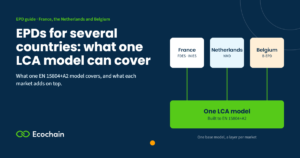
- One LCA model built to EN 15804+A2 can be the shared base for construction product EPDs across Europe, so the product model and factory data can usually be reused, while scenarios, background data and verification change per country.
- National schemes sit on top. France registers FDES in INIES under a national supplement, the Netherlands checks EPDs against its own determination method before they enter the NMD, and Belgium adds B-EPD and TOTEM rules.
- Programme operators also differ on methods such as module D and on how far products can be grouped, so the choice of programme is best made before modelling starts.
- What seems to work for manufacturers selling in several markets is one base model and one set of factory data behind every country version.
A Belgian tender asks for an EPD, and in the same week a Dutch customer wants your product in the NMD. You already have a verified EPD, so it should be a matter of sending it on. But each programme operator has its own template and its own checks, and a national database can ask for its own version.
When a manufacturer sells the same product into four or five countries, the question changes from „do we have an EPD?“ to „which versions of it do we need, and in what order?“
Why one EPD rarely covers every market
EN 15804+A2 gives Europe one core method for construction product EPDs, but each market builds its own layer on top. Some countries add a national supplement or make choices the standard leaves open, and buyers in each market look products up in their own database, often the one their building calculation tool reads from.
The Dutch case shows how this happens. Stichting NMD says a foreign LCA or EPD must meet its own method on top of EN 15804, and often needs adjusting first (Stichting NMD).
One customer is mapping its 15 main product groups against the French, Dutch and German schemes, to see which declaration each group needs. A coatings maker needs EPDs for Belgium, the Netherlands, France and the UK, and finds that diverging PCRs and platform rules add modelling work every time.
Is an EN 15804 EPD accepted across Europe?
Between programmes, often. Between national databases, much less: most programme operators work to the same standard and some recognise each other, but France and the Netherlands ask for their own version.
Many European programme operators belong to ECO Platform, an umbrella organisation that pushes for cross-border recognition of EN 15804 EPDs (IBU). France’s INIES hasn’t been allowed to publish new ECO EPDs since January 2025 (ECO Platform). Some programmes go further with bilateral agreements. The German IBU, for example, has agreements with programmes in the UK, Italy, Spain, Denmark, Norway and Sweden. Its agreement with France’s INIES is suspended: under EN 15804+A2, France requires a new verification. IBU lists no Dutch or Belgian programme (IBU).
Recognition between programmes isn’t the same as acceptance in a national building database, though. A database with its own method can still ask for a recalculated version.
What do France, the Netherlands and Belgium require?
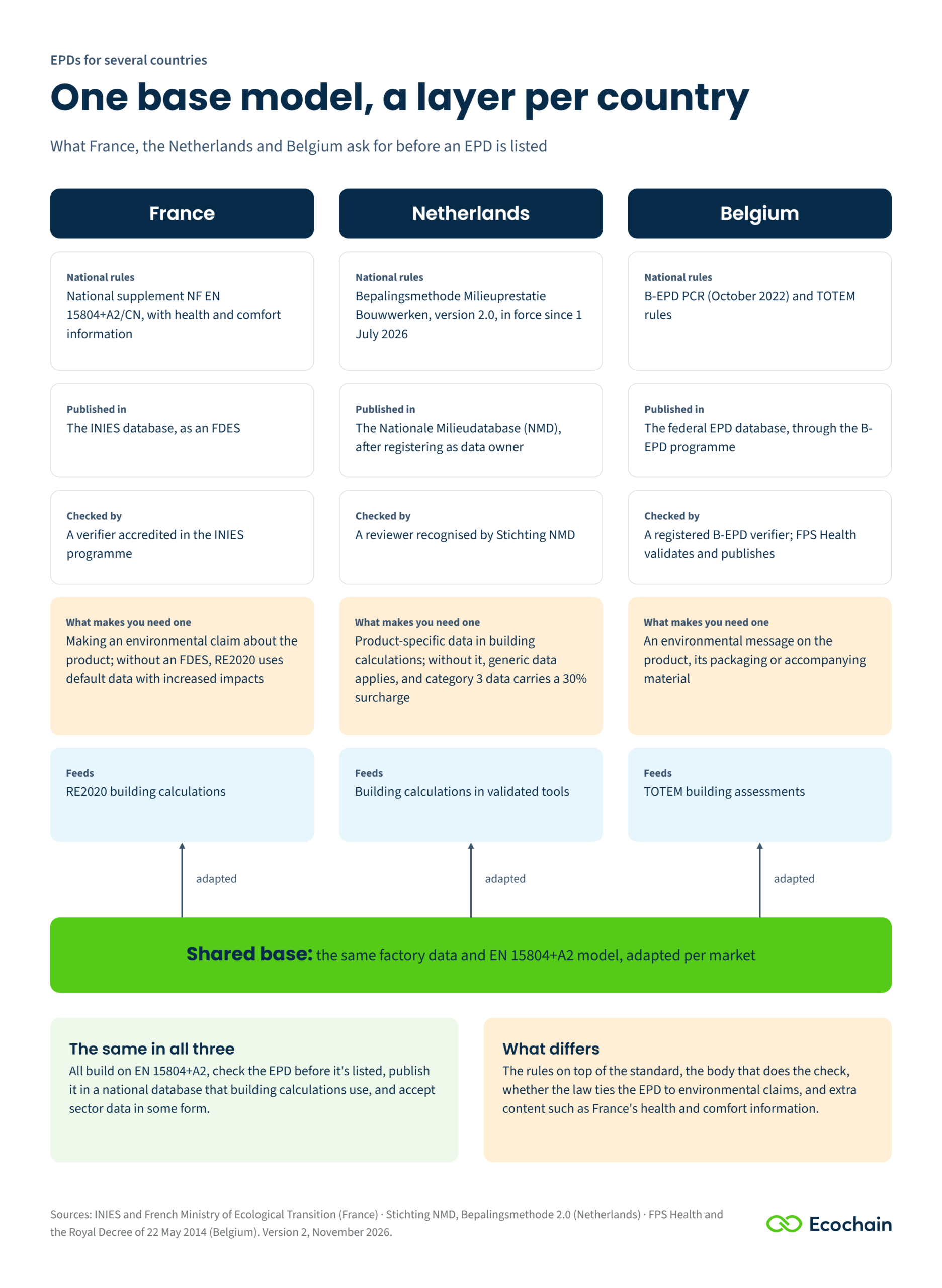
All three start from EN 15804+A2 and check an EPD before it’s listed. They differ in the national rules on top, the body that does the check, when the law asks for an EPD, and what else goes in it.
| What it takes to publish | France | Netherlands | Belgium |
|---|---|---|---|
| Shared base | EN 15804+A2 | EN 15804+A2 | EN 15804+A2 |
| National rules on top | The national supplement NF EN 15804+A2/CN | The Bepalingsmethode Milieuprestatie Bouwwerken, version 2.0, in force for Dutch building calculations since 1 July 2026. It works as a generic PCR for construction products and makes some optional EN 15804+A2 choices mandatory | The B-EPD PCR (version of 18 October 2022) and TOTEM rules on top of EN 15804+A2 |
| When the law asks for an EPD | When the manufacturer chooses to make an environmental claim about the product (decree of 23 December 2013). Without an FDES, RE2020 calculations use default data with increased impacts | No general duty per product. A product without its own entry is calculated with generic data, and generic category 3 data carries a 30% surcharge | When the product, its packaging or accompanying material carries an environmental message. The EPD must be registered first, and the database web address shown under the message (Royal Decree of 22 May 2014, Art. 2–3) |
| Where it’s published | The INIES database, as an FDES | The Nationale Milieudatabase (NMD), after registering as data owner; often alongside an MRPI EPD. | The federal EPD database, through the B-EPD programme run by FPS Health |
| Who checks it | A verifier accredited in the INIES programme, against the standard, the national supplement and French rules | A reviewer recognised by Stichting NMD, under the NMD verification protocol | A verifier registered with the B-EPD programme, after which FPS Health validates and publishes |
| Extra requirements | Health and comfort information – the „sanitaire“ in FDES | The functional unit must match an NMD functional description | The functional unit is aligned with TOTEM |
| Sector data allowed | Collective FDES for a sector | Brand data (category 1), sector data (category 2) or generic NMD data (category 3) | A registered collective profile, if it represents your product and its owner agrees |
| What it feeds | RE2020 building calculations | Building environmental performance calculations in validated tools | TOTEM building assessments |
| Sources | INIES verification, INIES default data, French ministry (decree) | Bepalingsmethode 2.0, in force 1 July 2026, NMD data categories | B-EPD, B-EPD documents, Royal Decree |
For electrical, electronic and HVAC equipment, France uses the PEP ecopassport instead of an FDES (INIES).
What’s the same: all three build on EN 15804+A2, check the EPD before it’s listed, publish it in a national database that building calculations draw on, and accept sector data in some form.
What differs: the rules on top of the standard, the body that does the check, whether the law ties the EPD to environmental claims, and extra requirements such as France’s health and comfort information. Germany has a national database too: ÖKOBAUDAT, which takes EPD data from accepted programmes such as IBU (ÖKOBAUDAT).
Grouping rules can also change at the border. Dutch rules allow one scaled declaration for a size range if results stay within 10% per impact, and expect a split when differences exceed 20%, with exceptions such as a proven worst case. IBU allows average, representative and worst-case EPDs, and asks for the GWP spread to be stated for the first two (Bepalingsmethode 2.0, §2.6.6.2 and §2.11; IBU PCR Part A, §5.3.1).
Can a French FDES become a Dutch NMD EPD?
Not as a conversion. The factory data can often be reused, but method, background database, scenarios and report change, so plan it as a new Dutch project from the same data.
An HVAC manufacturer asked us exactly this: can an existing French declaration be converted efficiently into an NMD EPD? An FDES is built to EN 15804+A2 plus the French national supplement, and the NMD has its own method on top of the same standard. Where they differ, the Dutch rules decide.
The NMD has worked on this. MRPI published a checklist in May 2021, and since May 2025 the NMD also offers a decision tree and checklist for non-Dutch LCAs and EPDs (Stichting NMD). For the Dutch side in detail, see Publishing EPDs in the Netherlands: 13 FAQs about NMD and MRPI.
Why can a low-carbon gain get lost in the NMD?
Because background data matters as much as your own data.
The Dutch method requires ecoinvent 3.9.1 (Bepalingsmethode 2.0, §1.2). A supplier EPD built on another database needs extra analysis before it may be used, and a low-carbon gain can get lost on the way (Stichting NMD guidance, May 2026). It helps to ask suppliers early for a version that fits.
Do programme operators differ on methods?
Yes, and the differences can hold up an EPD.
One manufacturer’s first EPD was delayed by a module D method difference between two programme operators. In the end they chose the programme their competitor used, so both EPDs would follow the same rules. Another, a coatings maker, worries that different product category rules per programme operator could mean several verifications and model variants for the same products.
Before modelling, a short list of questions to each programme operator on your shortlist can save rework:
- How do you handle module D, and does that differ from the programmes our competitors use?
- How far can similar products be grouped into one EPD?
- Which national databases list your EPDs, and on what terms?
- Do you have recognition agreements with programmes in our other markets?
- Which template and language does the declaration need?
There’s more on the choice itself in Choosing an EPD program operator that suits your publishing needs.
How do you plan EPDs for several markets from one model?
Start from where your buyers look, then build one base model with a layer per country.
- List your markets and where each one looks. Tender requirements and national databases differ per country, and they decide which version you need.
- Build one base model to EN 15804+A2. Use product-level data and shared components, so country versions differ only where the rules do (see our data foundation guide, IND-4 [link to confirm]).
- Map the country layers. For each market, note the supplement, the method choices, scenarios, background data and language.
- Choose programme operators with recognition in mind. One verification that several programmes accept usually costs less than one per market, outside France and the Netherlands, which check against their own rules.
- Sequence verification. Start with the market that matters most, and ask before the second verification whether the first can be reused. One coatings maker knows the Netherlands needs its own verification, but not whether Belgium, France and the UK can share one.
- Keep country versions linked to the base. When a supplier or an energy contract changes, every version can be recalculated from one place. Published EPDs stay as verified; a change of 10% or more on an indicator is a reasonable trigger to contact the verifier.
A rough guide to where to start:
| If… | Then a sensible first step is… |
|---|---|
| Most of your tenders are Dutch | The NMD route: data that meets the Dutch rules also meets EN 15804, so it stays usable elsewhere |
| Your main customers are French | The FDES and its INIES registration from day one |
| You sell in markets without a national database requirement | An EN 15804+A2 EPD with a programme operator whose EPDs are widely recognised |
| Verification per product is your biggest cost | Grouping products where each market’s rules allow it |
From the field
In calls this autumn, manufacturers selling into several European markets described the same difficulty: each country adds its own rules, checks and cost.
- A door manufacturer caps how many variants get an EPD because each verification costs money. France could have had nine, but cost held it back.
- The same manufacturer finds that national supplements such as the Dutch NMD and French FDES rules add management work and room for error.
- A coatings maker wants to make EPDs in-house because more public tenders across several countries now require them.
- One manufacturer found registration in the Belgian database slow. The programme’s own instructions mention several weeks to several months.
Where to go next
The pressure to serve several markets is growing. Under the new Construction Products Regulation, environmental information will move into the declaration of performance and conformity product family by product family; the first families are indicatively due in 2028–2029. National building rules can stay, but once a family’s new EU standard applies, their assessment methods must follow it (CPR Article 11). Expect national databases to adapt, not disappear. Our CPR guide explains the background.
Dutch end-of-life scenarios change too: usable from 1 January 2027, mandatory from 1 July 2027 (Stichting NMD).
What seems to work is one model with country versions on top, so a new market starts from the same data instead of from zero. If you’re mapping which EPDs you need for 2027, one of our specialists can help you work out which country version to start with in a 20-minute call.
FAQs
Is an FDES the same as an EPD?
An FDES is the French form of a construction product EPD. It’s built to NF EN 15804+A2 and the French national supplement NF EN 15804+A2/CN, and verified by a verifier accredited in the INIES programme before it’s registered in the INIES database. So it follows the same European standard as other EPDs, with French rules added on top (INIES).
Do we need a separate verification for each country?
Not always. Some programme operators have mutual recognition agreements, so an EPD verified in one programme can be listed in another without a new verification (IBU). France and the Netherlands are exceptions: an FDES needs its own verification, IBU’s agreement with INIES is suspended, and the NMD checks EPDs against its own method before inclusion. Belgium can recognise a verification that meets Articles 7–9 of the Royal Decree (Art. 10).
Which database do Dutch building calculations use?
The Nationale Milieudatabase (NMD): validated calculation tools read product environmental data from it. Product-specific entries follow the Bepalingsmethode Milieuprestatie Bouwwerken, version 2.0, in force since 1 July 2026, and a reviewer recognised by Stichting NMD checks them before inclusion (Bepalingsmethode 2.0). Our NMD and MRPI FAQ covers the Dutch route step by step.
What do Belgian EPDs need?
Belgium runs its own programme, B-EPD, with the Federal Public Service of Health as programme operator. It applies to building products on the Belgian market. To be registered, an EPD must meet EN 15804+A2 plus the B-EPD PCR and TOTEM rules (FPS Health). The programme’s own instructions mention several weeks to several months for registration, so it helps to plan for that.
Why does module D differ between programmes?
Module D reports benefits and loads beyond the system boundary, such as from reuse or recycling. Programme operators can interpret its calculation differently. In the Dutch method, a net loss of secondary material sets module D to zero; the German IBU rules allow it to be declared (Bepalingsmethode 2.0, §2.6.3.5; IBU PCR Part A). One manufacturer we spoke to saw their first EPD delayed by this kind of difference. Asking each programme how it handles module D before modelling avoids a late surprise.
When do EPD obligations actually apply?
It depends on the market and the product. National schemes in France, the Netherlands and Belgium already shape what buyers and tenders ask for, and the new CPR adds EU-wide requirements one product family at a time. Dutch building limits widened to schools, shops, care and industrial buildings on 1 July 2026. Under the EPBD, life-cycle carbon must be disclosed for new buildings over 1,000 m² from 2028, and all new buildings from 2030. Our CPR guide explains the background.