What happens if you don’t comply with the new Construction Product Regulation (CPR)?
Are fines the biggest risk here, or is there something more strategic at stake?
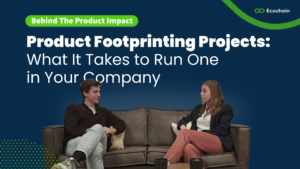
In the first episode of our brand new video series, Behind the Product Impact, Pratik Gholkar and Emma Thunnissen point to something bigger: market access – and the revenue that depends on it.
When your data is structured and compliant, you’re not just ticking a legal box to avoid fines. You’re also securing your place as a preferred supplier across EU projects.
Think of it as future-readiness. Instead of reacting to tender requests with uncertainty, companies that embrace CPR now are:
➡️ Securing their seat at the table: Ensuring they remain on the preferred supplier list for major projects both now and in the future.
➡️ Empowering their sales teams: Providing the verified product impact data needed to win in a market that increasingly demands transparency.
➡️ Building a foundation: Moving from a “one-man job” to a collective company responsibility that protects the bottom line.
Video Transcript:
Pratik: CPR is no longer a myth. It’s the reality. Having EPDs is your future readiness.
Emma: What happens if you don’t comply?
Pratik: Revenue impacts are way bigger than the fines.
Emma: What if I want to get started as a company where should we start?
Pratik: Compliance to CPR is just not a one man’s job. It’s the company’s responsibility.
Emma: Managing product. Sustainability isn’t easy. Regulations keep shifting. Expectations are changing, and the playbook isn’t always clear behind the product. Impact is our series for exactly that reality. Your front row seats to the questions best practices and operational decisions sustainability teams face every day to understand, communicate, and improve their product’s impacts.
Emma: Hi Pratik. We’re here today because the new CPR is going to change a lot for construction product manufacturers, and we’re hearing a lot of confusion and questions and uncertainty. So, nice to have a conversation about it and maybe clear up some things, regarding the CPR. So maybe we can start with a short introduction of the CPR.
Pratik: Thank you, Emma, for having me. It’s always pleasure to talk about new regulations coming up and how we can help customers. What I really liked is your framing, the way you framed it, new CPR. And this is something I want to highlight. It is not something completely new. It is the adaptation or amendments in the old CPR. So the CPR was already existing. The 2024 CPR is amendments in the old CPR.
What does that mean? By end of 2024, construction product regulation entered into EU journals.In 2025, it came into force. From 2025 till 2026, there was a transition period for customers to understand and abide by the new regulation. And from 8th of January, 2026, it is mandatory to declare the GWP. What do you mean by GWP? This is the global warming potential of your product in the construction and building materials.
Emma: Okay. So I’m hearing that in 2026, actually a lot is changing right now for construction product manufacturers because they have to declare this GWP?
Pratik: Exactly. Yes. And that’s just the beginning. In the due course of time, they should be declaring all the Impact categories, which are mandatory by CPR regulation.
Emma: So for these, impact categories for sure, I will need an LCA. Do I also already need an LCA for this GWP declaration?
Pratik: Absolutely. Even for GWP declaration, you need an LCA.
Emma: I’m hearing that a lot of construction product manufacturers are now gonna have to start doing LCAs if they haven’t already been doing them.
Pratik: So starting now is definitely helpful for them to win in the longer race.
Emma: Okay. So maybe if we start with, how do you know if your products need to comply to the CPR?
Pratik: You can always look at the EU website and there is a dedicated, guideline. You can go through the section and articles mentioned in the CPR and you will find a complete list of products which are covered under CPR regulation. You will also find the prioritization of those products in the CPR.
Emma: So what you’re saying is that not all products will have to comply and do those impact categories at the same time, but it will go over time.
Pratik: Exactly. One of the key mandate Of CPR is to have harmonized standards. So the way the harmonized standards will come in force are by section, by section, segment by segment in the construction, product itself, category itself. Yeah. And that will happen in a sequence.
Emma: So you can look up which ones are being prepared right now and which ones will be prepared soon. And then based on that, you can see when your product might need to comply.
Pratik: Easiest way: Send a message to me. I’ll help you out.
Emma: Okay. That’s, great to know, I think. Then I think, a very important question also to ask is: What happens if you don’t comply? Will you, for example, get fined? Or what are the consequences?
Pratik: Really good question Emma. And what I want to highlight here is to make our customers aware that it is not about a fine. Okay, the fine is a small part of the CPR.
Pratik: In a bigger context it is the revenue impact that it is gonna have. Imagine you sell your product in say, 50 different locations across the EU, and you are one of the key suppliers. But if you do not have the documents compliant for that product as per CPR, you’ll be dropped out of the suppliers list. What does that mean? Is the customers whom you were already supplying to, may not be buying from you anymore. And imagine what a business it would be, where you cannot sell.
Emma: I think this is most businesses’ worst nightmare. Exactly. So you’re saying actually that the indirect financial consequences, might be way bigger than the fines actually.
Emma: It’s already really important for your business to just have these numbers in general.
Pratik: Revenue impacts are way bigger than the fines.
Emma: I think that’s also interesting because actually as a LCA practitioner and like a software company that we are, we also do see often that the salespeople of a company are actually our customers. So it’s not just sustainability managers or, other, sustainability related actors, but we actually also have quite some customers where we’re directly in touch with their salespeople.
Pratik: And this is something I want to highlight. Compliance to CPR is just not a one man’s job. It’s the company’s responsibility. Wherein a company needs to put a plan to be compliant with CPR in order to avoid all the fines, which will be there from 2027 onwards. But that’s just a small portion. And the bigger revenue impacts, which will start happening. And the sustainability manager is responsible to execute those plans. So the execution stays with sustainability manager, but the bigger responsibility of making a plan and how do we go about it, is a company responsibility important to stress, I think.
Emma: So, what if I want to get started as a company and make sure that we do the right things right now, where should we start? What should we prioritize?
Pratik: There is a single line answer to it. Start small. Start now. Okay. Identify your portfolio. Which products abides or which requires CPR compliance immediately? Because it might not be the case that your complete portfolio requires CPR compliance right from now.
Pratik: Right. Identify those products then among those products identify which are your high selling products. You start with those products first. What you need to start is building a foundation. Foundation is a key to success in CPR compliance. What do I mean is, usually companies have their bill of material in LCA language, we often call it BOM and they have the transport data available from their suppliers to make those products.
CPR compliance, in which LCA is the mandatory step, needs a variety of data. Which is far more than just the bill of material and transport. You need to gather that data and structure it in such a way that it can be utilized to make LCAs and in turn make it compliant for CPR. So that’s where companies should start.
Emma: So, first off, start with the products that will be the first to have these full LCAs and also start with products that are commercially interesting to you. So your biggest sellers. And then the second thing I’m hearing is that data collection is very complex, and I, as a LCA practitioner, can actually really, say that that is true. For example, we see a lot of companies that get delays in our projects because of the data collection.
And, in general, we’re seeing a lot of overwhelmed people at the start of projects for example, they need a lot of different people, the data comes from all different places in the company, so we see a lot of challenges with that in general. So I think it’s always good to start with that. And it always takes longer than you think, right?
And I think it’s also in general, important to think about the fact that it’s not, embarrassing or it’s not bad to ask for external help. It is important to. work with experts and actually build in-house knowledge about these type of topics, because you need to do it yourself in the end, and you need to do it for your full portfolio. And it’s not a short term thing. It’s gonna stay.
Pratik: CPR is going to stay. Something I often say, right: CPR is no longer a myth. It’s the reality.The sooner you accept it, the better you will get at it. And that’s, what we need to accept, that CPR is there and we need to abide by it. And as you rightly said, right, setting up a company for success is a process. And we are well acquainted with that process. Making LCA is one thing, getting a verified EPD is a another ball game.
Emma: LCAs are not necessarily easy. EPDs are also not necessarily easy to do. I think that’s also very important to say. However, I do think that it’s important that we empower companies so that they can start doing these things themselves. Okay. But back to the CPR topic. So let’s say I’m a sustainability manager now, how do I internally communicate about the CPR? How can I somehow show the importance of this topic?
Pratik: This is a very repetitive question I get. In my webinars as well. And. what I have often seen, with customers is: There is a gap between the implications of law and the direct revenue impacts. If the sustainability manager is clever enough and clear to bridge that gap, I have seen most often higher management getting convinced and then they form a plan.
Emma: So your advice to get started is focus on the revenue impact, and just, work from there.
Pratik: What I mean by focus on the revenue impact is make the company aware of what revenue impacts they will have if they do not comply with the CPR.
Emma: Okay. Very, very good advice. Then maybe if we talk about EPDs a little bit more, because of course we have a lot of customers that have EPDs with us. Do they automatically comply to the CPR if they already have EPDs?
Pratik: The answer depends on two factors. If the quality of your EPD is good, then yes, you become compliant. But if the quality of the EPD is not up to mark, then unfortunately you are not compliant with the CPR. And what I mean by that is, and recently you, you have seen these discussions happening around about the quality of EPD and everything, just mere having those environmental impacts is not an EPD. It needs to be third party verified. It needs to be approved by the EPD PO. And if you have everything in place, then yes, EPDs can be directly correlated to DoPCs.
Pratik: Provided all the information that is required by DoPC is in your EPD document as is. And then later it can also become part of a bigger game called DPPs. digital product passports.
Emma: And maybe a follow up question on that: does the company need to have EPDs to be compliant with the CPR? Or can you also be compliant without EPDs?
Pratik: Again, the answer is twofold. The answer is yes and no. As a law, what you need to have now is a GWP impact, right? The short answer could be no, with just GWP I am compliant. But, there is a DoPC there as well. So to be compliant with the DoPC, you will need to have EPDs. Okay. So I suggest, to have third party foolproof EPDs. Having EPDs is your future readiness.
Emma: So it’s a way to start now. To have the results. To know what to do and to be on time. And, maybe also good to know, so Pratik just mentioned DoPC and DPPs we will actually be doing next episode on DPPs. So if you have questions about DPP in general, leave them under this video and let us know.
And, check out our next video on that one. To close off this video in a more empowering way and to also give some advice. What do you think manufacturers are currently doing wrong, regarding CPR? What should they change and do you have any advice for them?
Pratik: Accept that the CPR is there. It is no longer a myth. Right. And start working towards it. And what manufacturers are doing wrong, as of now, is they have a belief that they have their data already in place. Which is required for LCAs. And that’s a wrong assumption. And why I’m saying that is most often they have the data, but it is not structured to do LCA. You need the data in a proper structure to do LCA and that is something missing. So having your foundation ready, which scales with your operation is something that will set you up for a greater future.
Emma: And in general, I think maybe two things. So first off, I think the awareness of what data exactly to have is often lacking when companies haven’t started yet. So it gets very overwhelming. But also, it can just really help to have an expert to guide you. I think having an expert and being empowered is something really important to be able to handle this type of thing.
So with that, I think it’s time to close off this video. However, if you want to learn more about CPR, we actually just did a webinar with Pratik, about the CPR. So you can also watch that webinar. And we also have a upcoming blog post with more information. So check that one out as well as soon as it’s out. You’re always free to get in touch with us and ask some questions. You can also ask your questions under , the video. So, we we’d love to hear from you.
Pratik: Thank you for having me Emma. Yeah, thank you as well.